

Join the mailing list!
You learned about investing. You held your horses. You did the research, checked the fund and finally built up the courage to press the button.
£10,000 invested.
The next morning: £9,920.
Seeing your investments fall feels horrible, particularly when you have only just started. You finally did the thing you had spent weeks or months learning about and the market rewarded your bravery by immediately taking some of the value away.
So you check the news, hoping for reassurance. Instead you find an entire internet full of reasons to worry.
AI bubble. America is overvalued. Markets might crash. Interest rates. Elections. Recession. Somebody on Facebook thinks the apocalypse is arriving on Tuesday.
You check your investment again. It is still down, and suddenly all those lessons about volatility feel rather different.
It is one thing to sit in Rebel Finance School while Alan and Katie wave their arms around and show you charts of stock market crashes. It is another thing entirely when you open your own account and see your own money falling.
Because now it is your money.
If this is you right now, breathe.
You haven't discovered some secret flaw in long-term investing that everybody else missed. You are experiencing the reason we spend so much time talking about volatility in Rebel Finance School.
We don't teach volatility because we want you to memorise a load of stock market history. We teach it because sooner or later your investments will fall, and knowing that intellectually is very different from actually living through it.
Please stop checking.
Seriously. We love you. But if you invested this money for the next 10, 20 or 30 years, why are you checking what happened to it this afternoon?
We completely understand the urge.
You finally put your money into the market and suddenly every tiny movement feels enormously important.
Down 0.8%.
Down £200.
Down again today.
Your brain wants to know whether you made the right decision.
But why are you measuring a decades-long investing strategy after seven days?
The timescale of the decision and the timescale you're using to judge it are completely different.
You carefully choose your spot. You plant it. You water it. You give it everything it needs.
Then the following Tuesday you dig it back up, inspect the roots and shout:
“WHY ARE THERE NO APPLES?!”
That would be ridiculous and the kind of thing I might have done in the past!
And yet we can do almost exactly the same thing with our investments.
The investment was chosen for the long term.
You don't need to know what your investment did today.
You need a strategy you understand and can actually stick to.
This isn't the plan going wrong. This is the plan happening.
Investments move in value. They go up, they go down and sometimes they go down a lot. That is volatility, and it is part of investing rather than an unexpected malfunction.
The market will wobble.Your job is not to wobble with it.
Zoom in on one red day and it can feel terrifying. Zoom out and that day becomes one tiny part of a much longer story.
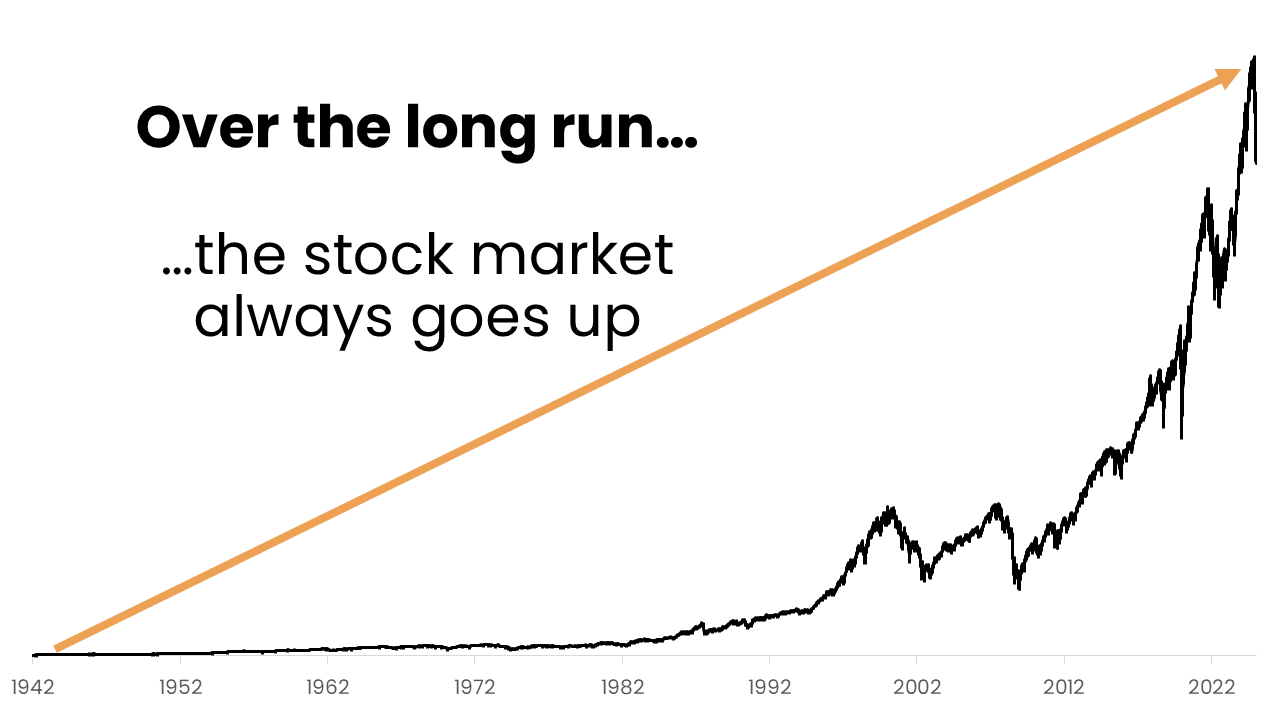
We cannot tell you what the market will do next. Neither can the person shouting about an AI bubble on Facebook, somebody on CNBC, or the bloke in the pub.
Worried about an AI bubble? That is a legitimate question, but the latest frightening headline should not become your investment strategy. We explored the evidence, valuations and global-index-fund implications in Are We in an AI Stock Market Bubble? A Global Perspective.
One day is almost a coin toss.
The shorter the period you stare at, the more investing looks like chaos. In the historical data we use in Rebel Finance School, the chance of a positive return over one day was 53%. The historical odds improved as the holding period grew.
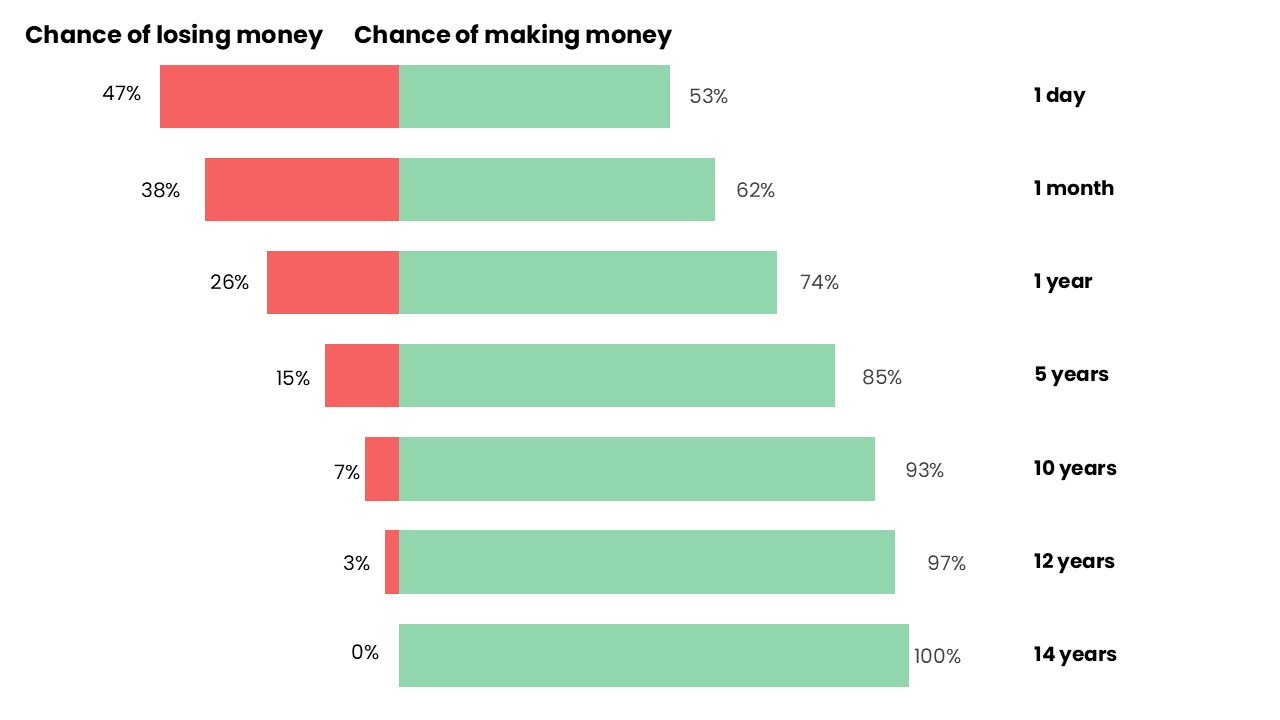
This is exactly why new investors can feel so shaken. One Rebel wrote, “Invested in VWRP a week ago and all I have seen is losses so far. My confidence is dropping, despite feeling confident after the course.”
Feeling nervous does not mean you failed to learn. It means the lesson has moved from a PowerPoint slide into your real life.
You are investing for decades, not seven days.
Let calm-you make the decision.
If you created an Investor Policy Statement, this is exactly when you need it. It records what you own, why you own it and what you decided to do when markets become uncomfortable.
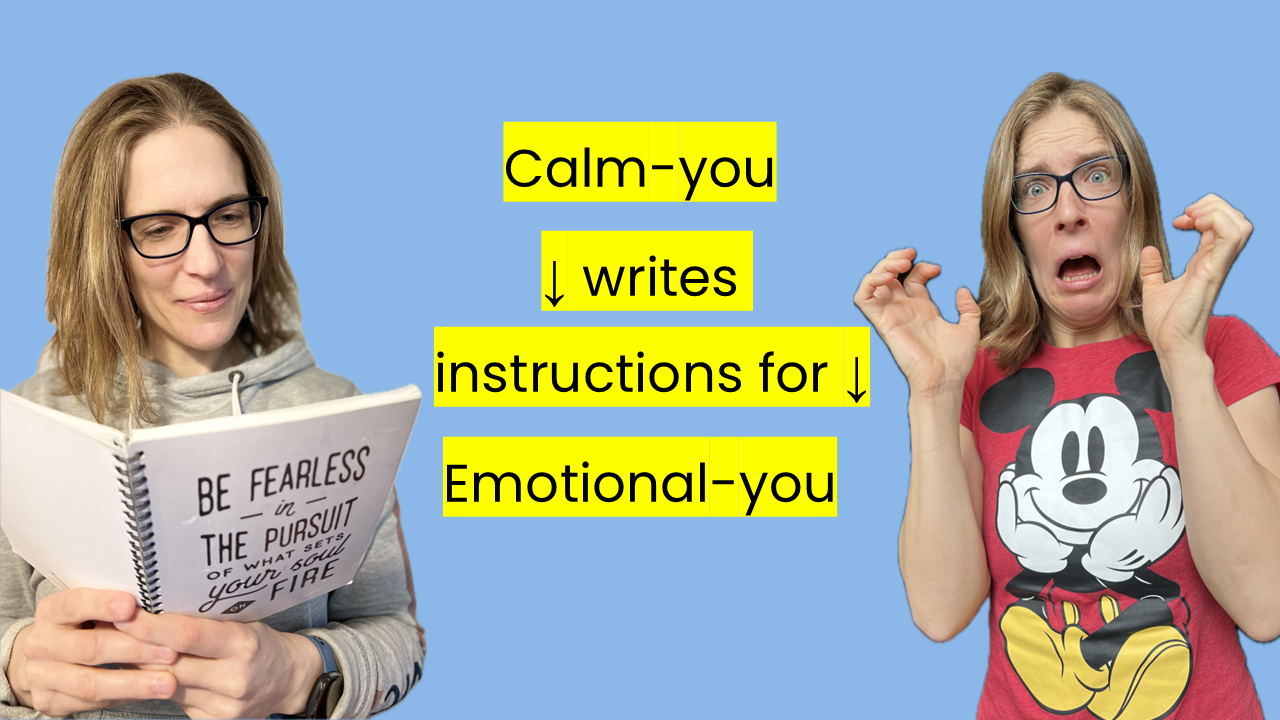
Has your strategy, timeframe or life changed, or has only the price changed? Do not invent a new plan while you are frightened.
Your five-step panic plan
- Stop. You do not need to act because the market moved.
- Zoom out. Remember when this money is actually for.
- Read your IPS. Let calm-you speak first.
- Stop checking. Close the app and step away from the scary headlines.
- Live your life. That is what the Freedom Fund is for.
You trained for this.
We were not preparing you for the days when everything was green and investing felt easy. We were preparing you for the red numbers, the frightening headlines and the urge to fiddle.
You planted a tree. Stop digging it up every morning to check the roots.
Now go and live your life.
Peace and Pineapples 🍍
Alan and Katie
Need friendly support from people on the same journey? Join the Rebel Finance School Facebook group.
We are not financial advisers and this is not regulated financial advice. Investments can fall as well as rise, and historical returns do not guarantee future returns. You are responsible for deciding what is appropriate for your circumstances.
4 Comments
Leave A Comment
Related Articles

Blog, Financial Independence, Save and Invest
Where do I put my money? Hello there! We wrote this article in 2025. Platform fees in the UK have changed a lot since then! Look out for an updated article coming soon.....With such a confusing array of platforms, funds and fee structures how do you ever decide where to put your money? In [...]

Blog, RFS2025, RFS2026
After every single Rebel Finance School session in 2025, Katie and I sat down and wrote notes about what we could improve for next time. We had a lot of ideas. But here’s the thing we’ve learned the hard way over the years: our ideas are not as important as what actually works for real [...]

Blog, Financial Independence, Keeping Track, Save and Invest
Where is your net worth? Most people have no clue what their net worth is, let alone where it is. Your net worth is the total of what you own minus what you owe. Your split is the shape of that number. How much is in your Freedom Fund? How much is [...]

A great post and probably one of your most important. The digging up of a tree is such a great analogy.
I stopped the urge to constantly look at my investments by DELETING the app from my phone making it much more time-consuming by having to log into the website. The very fact of making it less convenient has reduced the number of times I check to about once a month or even less.
Martin that is a GREAT tip, love it. Absolutely deleting the app and making it harder to check is so important. The digging up the tree analogy worked for me too. I have been so tempted when potting seeds in the past to check, “is it working!?” Thanks for commenting. You are AWESESOME. Alan
Fantastic post. Reinforces perfectly everything you taught on the investing part of the course. I invested my first ever £250 just two weeks ago (yes I know a whole £250) and it’s never been back to £250 since. But I know it probably will. After that I will invest another £250 next month. I think that’s the way to self teach yourself to not panic at the ups and downs. Maybe if you’re cautious, little and often is the way to learn and seems not so scary. I’m a graduate of RBS I can do it!
Love it Sara and nice work. 250 is AMAZING. what a brilliant start and doing it every single month in ups and downs is absolutely the way to get used to volatility! Thank you for commenting. Alan