

Join the mailing list!
What if teaching kids about money didn’t start with a worksheet, a lecture, or a slightly awkward school assembly?
What if it started with LEGO?
That is the question Katie and I came back from Denmark with.
Last month, March 2026, we went to Billund for the LEGO Inside Tour, an official three-day behind-the-scenes LEGO experience. Designed to give you access to LEGO history, special tours, designer sessions, and the wider world of LEGO in Billund.

For those of you that don’t know Lego was founded in Billund by Ole Kirk Kristiansen in 1932, it was originally a woodworking shop and made wooden toys and ducks and eventually pivoted to making plastic bricks in 1947!
We stayed in Billund for a week in total and also visited LEGO House and LEGOLAND Billund, but the thing that stayed with us most was not the trip itself.
It was the build challenge.
And the bigger idea we came up with for our model build.
I fell in love with Lego at a young age and I know LEGO could be a brilliant tool for teaching kids about money because it makes abstract ideas visual, physical, hands-on and memorable.
That is exactly what we tried to prove with our model, the Rocket to Financial Freedom. Read on to find out if we pulled it off, if the model actually worked or if the judges laughed us out of the building…
Why teaching kids about money matters so much
Money education is in our hearts.
Katie and I have spent years helping adults take control of their finances through Rebel Finance School (RFS). We have seen what happens when people finally understand spending, saving, investing, and how to build towards financial freedom. These concepts have the power to change your life!
We have also seen the cost of people not learning this early.
Confusion. Stress. Shame. Avoidance. Years of feeling behind. We meet people every year on RFS learning this in their 60s and 70s. What if we could reach them earlier?
And that is why this build mattered to us far more than just making something clever out of bricks. I didn’t want to just build a cool car or a robot, I wanted to build something that made a difference.
The real question was this:
Could we make money visible in a way a child could understand?
Could we show that:
- you earn money
- you choose what happens to it
- spending and investing lead to very different outcomes
- if you keep building the gap and investing it, something powerful happens over time
Because maybe the problem with money education is not that kids are incapable of understanding it. Not that they aren’t interested. Not that they have short attention spans.
Maybe the problem is that we usually teach it in ways that are forgettable, abstract, and deeply boring.
Maybe teaching kids about money does not need to start with worksheets and lectures. Maybe it starts with play.
That, for me, is the real heart of this whole story.
What is the LEGO Inside Tour?
If you have never heard of it, the LEGO Insiders Tour is a three-day official experience in Billund that takes fans behind the scenes of the LEGO world.
I got back into Lego as an adult when Katie bought me a Lego Ferrari for my 29th Birthday. Then I found Marvel Lego and started constructing buildings and the rest is history.
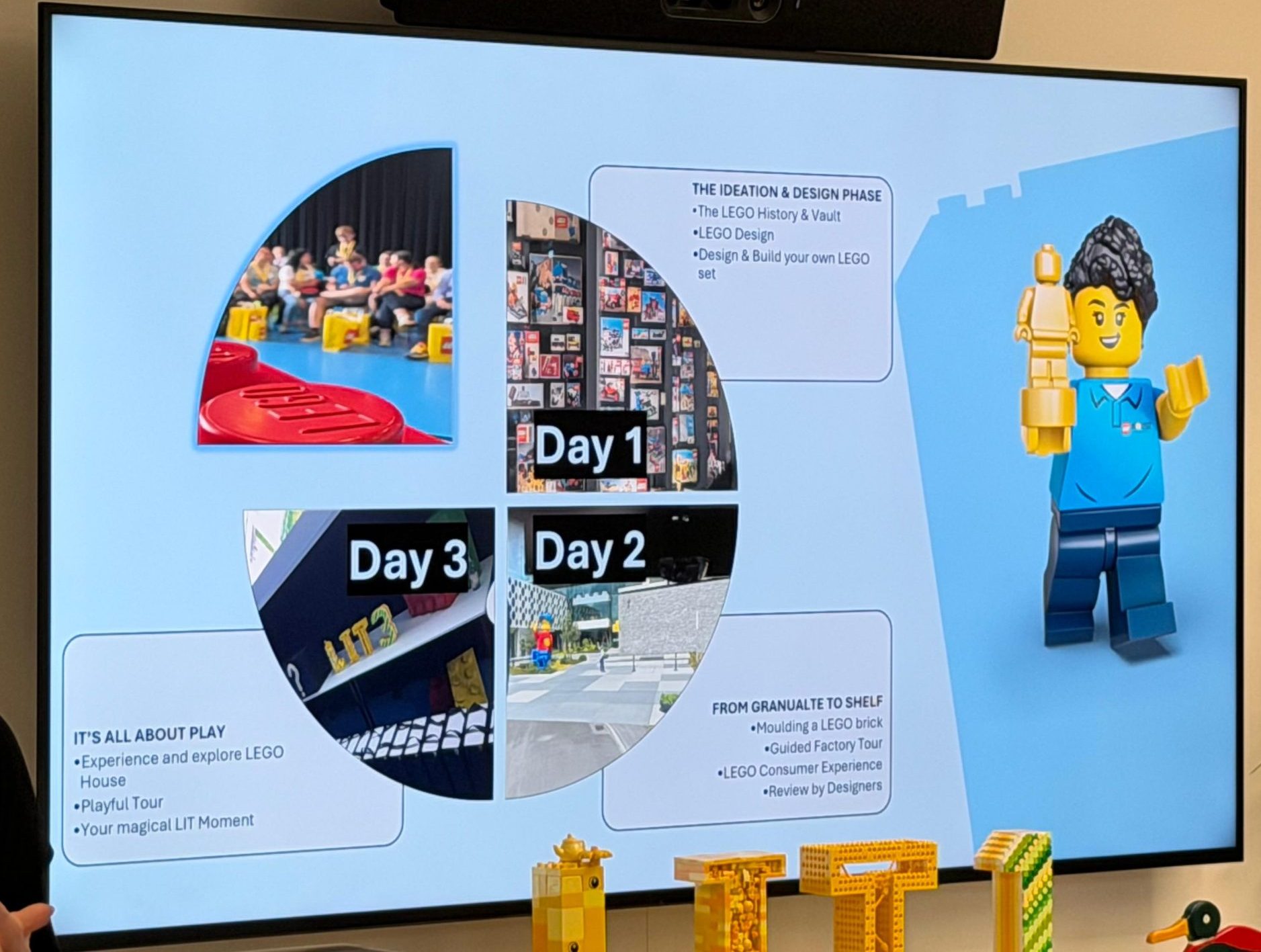
The Tour started with a visit to Lego Founder Ole’s house , moved on to a trip to The Vault, where there is one copy of every single Lego set every made and then a guided tour of the house with the Lego Historians. We then met 3 incredible Lego Designers responsible for some of my favourite sets ever.
We laughed as the told stories of building Lego Star Wars sets, designing the Titanic in Lego and making new elements out of thin air. I learnt so much.
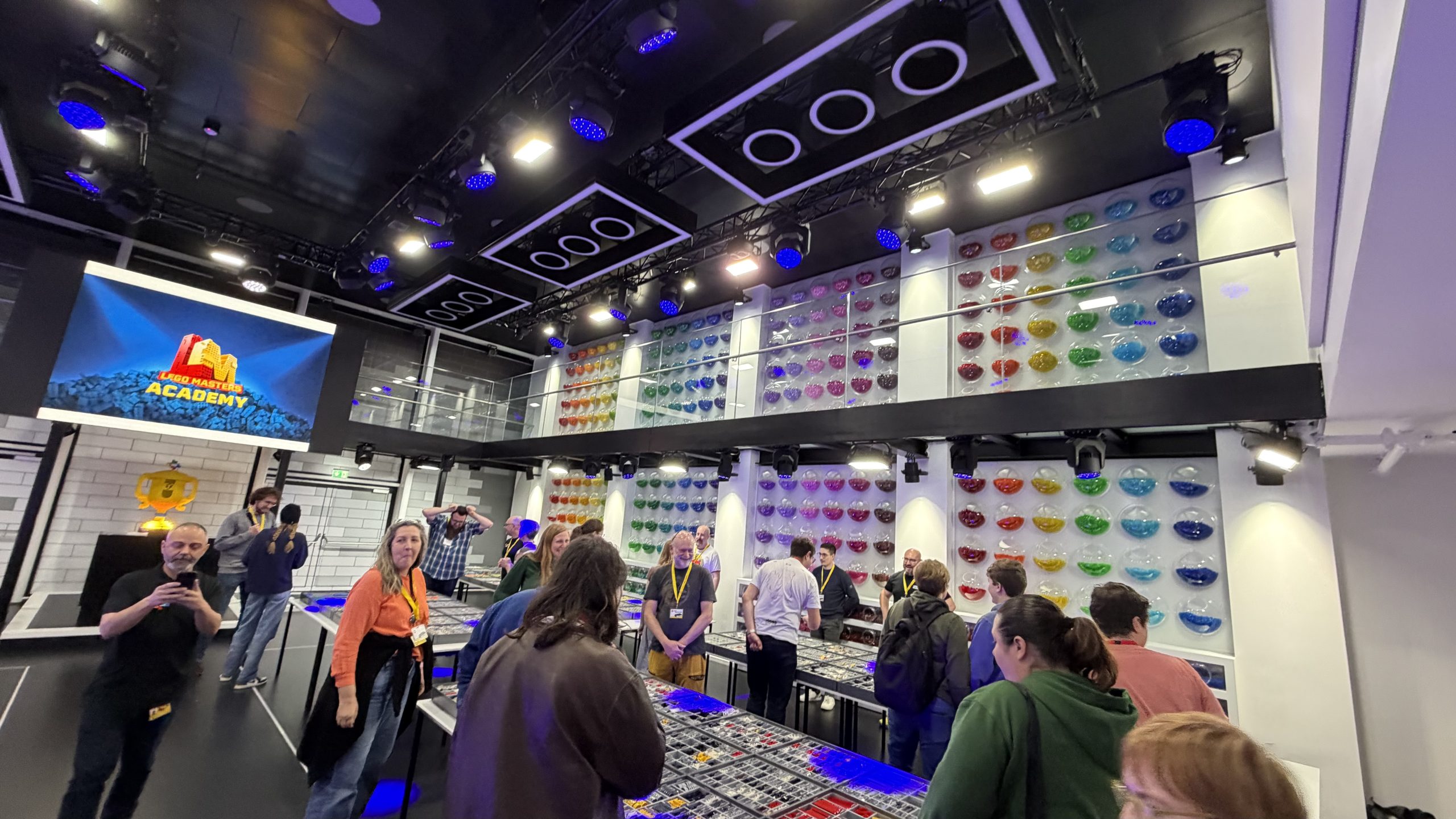
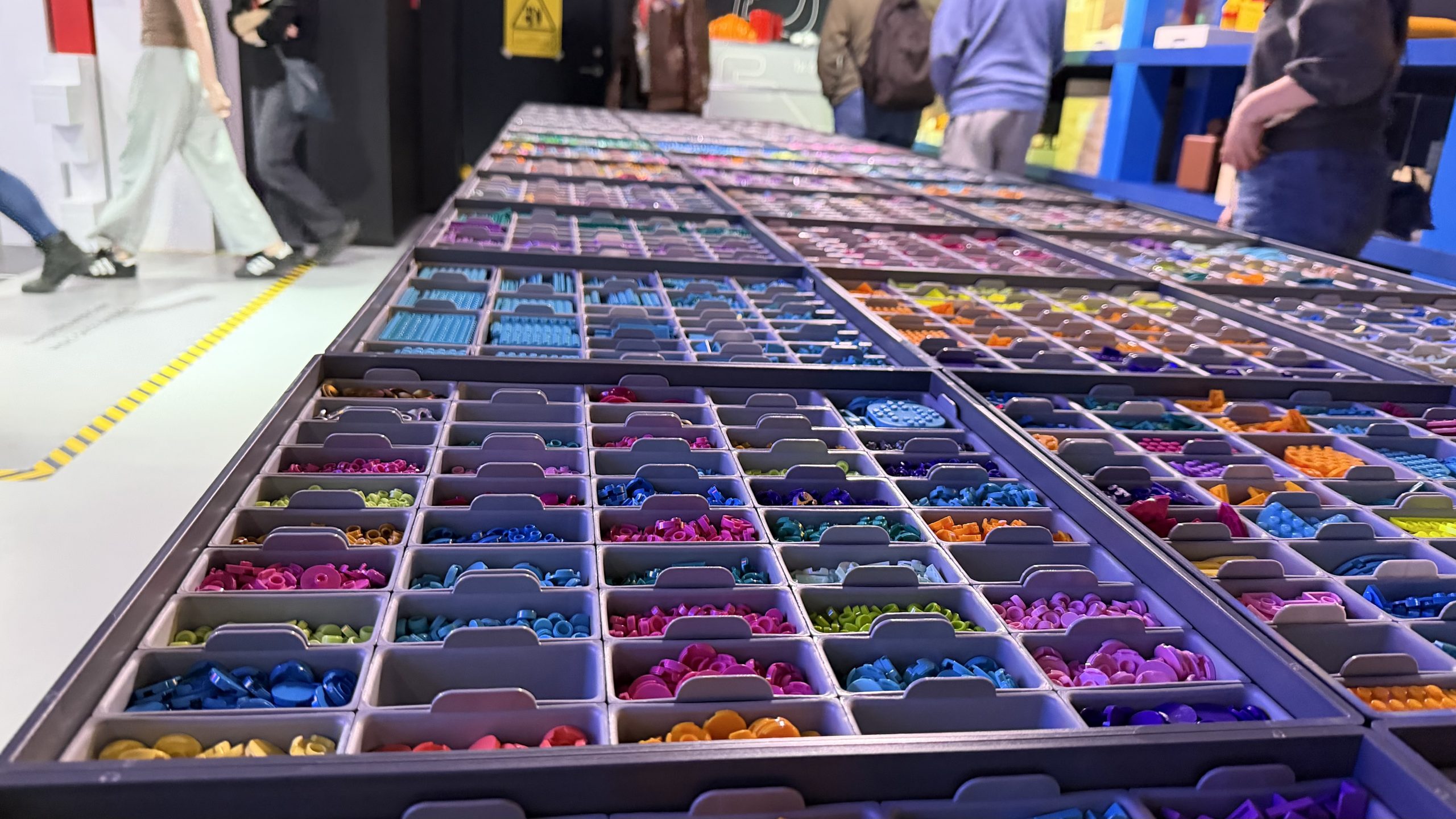
As part of the opening night, the designers set up a design challenge in the Lego Master room at the Lego House. It was magical going into the room set up just like the TV show, endless miles of bricks laid out in front of us and the endless possibilities of being able to build anything!
We had roughly two hours to build a concept model with around 400 elements. It had to function, impress the judges, and fit in the box.
So naturally, we decided that our entry should be about teaching kids about money.
Because apparently even on a dream LEGO trip, we cannot stop ourselves turning things into financial education. We are the Donegans after all!
From the Rebel Gap Method to Rocket to Financial Freedom
My first idea was I wonder if I can do something to show money coming in, money being spend and then saving and investing. the first name I came up with in my notes was The Gap Generator. I know, not super exciting, but you’ve got to start somewhere.
It was based on the core personal finance journey of income, expenses, gap, investing, time, and wealth. My brain first thought “good luck building that in bricks Alan!”
Over time the idea evolved into something more visual, more playful, and more exciting: Rocket to Financial Freedom.
And the metaphors were everywhere.
- Building finances brick by brick. You are literally building your financial future with every pound of dollar you invest.
- Building the life you want to lead. Piece by piece laying the foundations and building a dream future.
- Creating momentum.
- Launching your future.
- It felt playful, but it also felt deeply true.
How our Rocket to Financial Freedom worked
This was the model in simple terms.
You would crank to represent work and earning money. The cranking of a handle would produce coins. These coins represented your salary from your work of cranking the handle!
The coins would then travel down the system.
From there, I was trying to figure out a way to show savings rate or freedom rate as we call it. if you spend all your money you had nothing to show for it but if you invest it then it would grow.
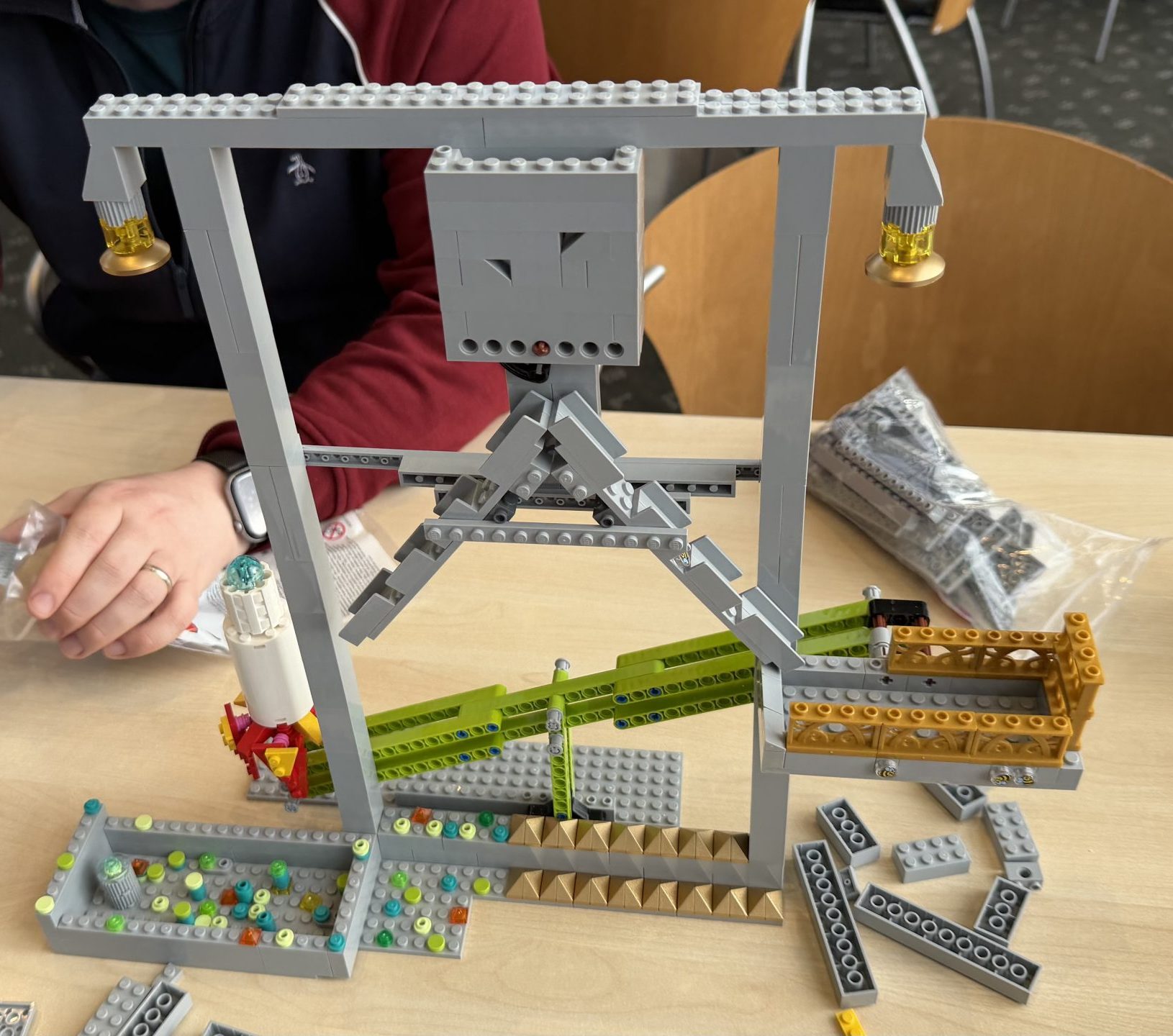
If the money dropped left it was spent, disappearing into what we jokingly called the toxic wasteland.
Or if the money went to the right it was added to your freedom fund or invest. It would literally drop down into a bucket called freedom fund where you would see the coins build up.
As more and more coins went into the fund, the weight would build. The bucket would get heavier and once enough had accumulated, the weight would trigger the mechanism and the rocket would launch.
That was the whole point.
A physical model showing:
- earning
- saving
- creating the gap
- investing
- reaching financial freedom
We don’t think small do we. Two hours to build all that? Do you think it is possible?
When you are teaching kids about money, one of the hardest things is that money often feels invisible. It comes in, goes out, disappears, and nobody can quite see what is happening. Especially now a days with credit cards and apps and everything is virtual, you barely see cash in real life.
LEGO changes that.
It lets a child see the choices.
It lets them touch the consequences.
It turns money from an abstract adult concept into a system they can actually follow.
The part where we nearly gave up
The Designers did a count down, shouted go and the music from the TV show played. Katie and I debated what to do, we ran off in different directions to find parts and started to build and very quickly realised we didn’t have the engineering skills to create something of this magnitude!
After about 30 minutes, I nearly gave up. I looked at Katie and said “this is too ambitious, in 30 minutes we have nothing to show but coins!”
The idea felt too far out of reach. I was loosing hope moment by moment and wondering if we should just build something easier.
This is where I want to say a proper thank you to Alex , the LEGO designer who believed in us when I was very close to abandoning the whole thing. He believed in the idea, he got involved and he said to me “If you aren’t going to build it now, when are you going to build it?”
We doubled down, I was running around the room grabbing Lego bricks, Alex was working on the tilt mechanism for the rocket launch, Katie was building the structure for the whole thing and we started to piece it together.
The time flew, it felt like seconds and they were saying half an hour left and we were NOWHERE close!
15 minutes left and I was panicking. Alex said grab the parts you need, you can build back at the hotel overnight and hand it in the next day.
We scattered to grab parts that we thought we might need, I filled our box with different parts and the time ended. I didn’t know how to feel, I was so inspired, so excited, full of adrenaline but with a feeling that we might not be able to finish this!
Building at breakfast
We got back to the room about 11:00pm exhausted and crashed into bed. But we set an alarm for 6:45am to be able to build at breakfast.
We got down early at breakfast and spread out the bricks and stuffed some eggs into our mouths between connecting our elements and building the structure.
Andrew who was on the tour with us sat and helped us build it, the comradery in the group was amazing. Andrew we could not have done this without you.
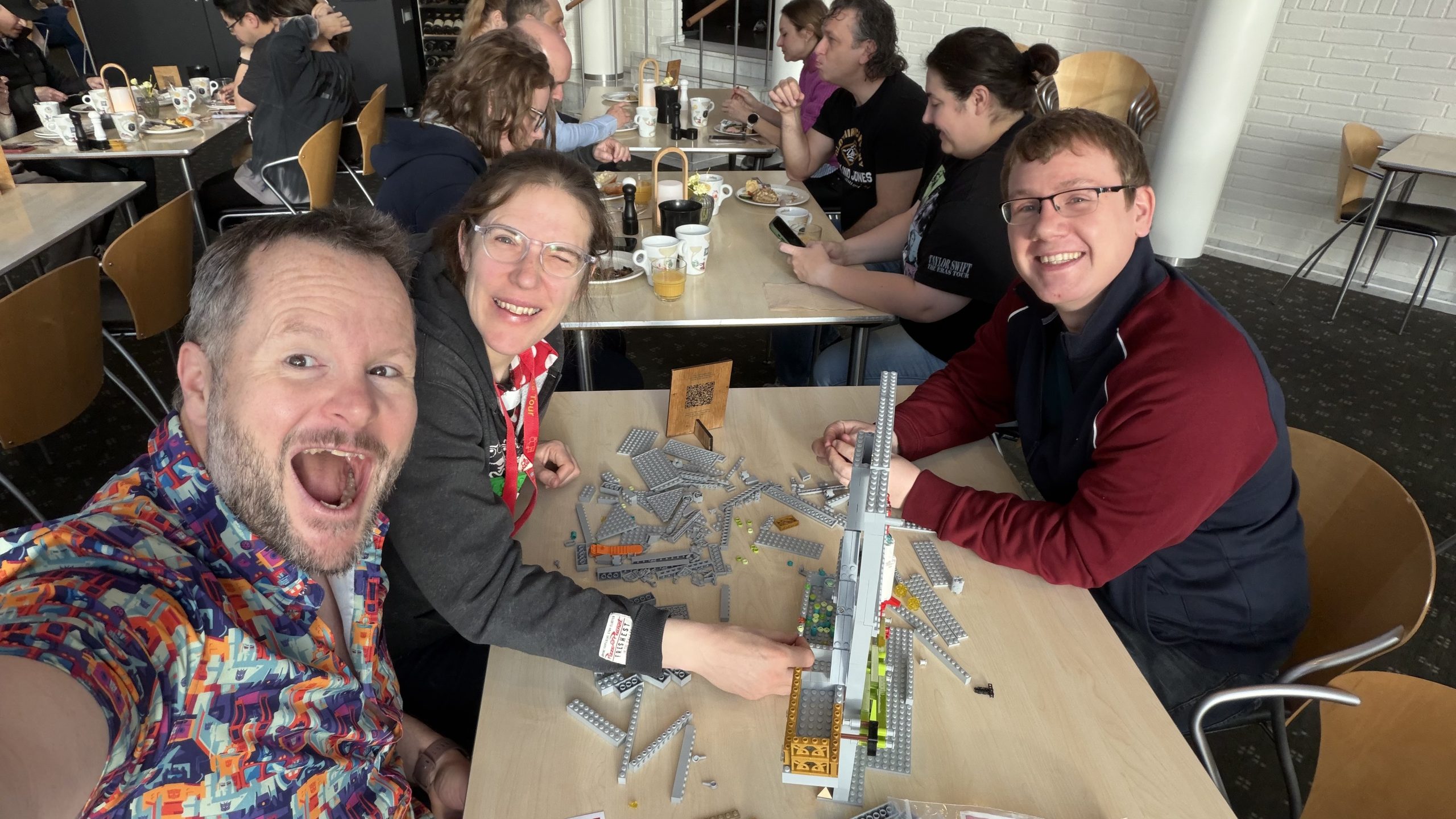
By the end of breakfast we had finished a working model, added some gold touches to represent wealth, built the toxic waste dump where the money spent ended up and laughed a lot.
The problem was the model didn’t fit in the official box, so in a panic the amazing staff of the Legoland hotel helped us find a food box big enough to take it, we still had to split it in two but we put post it notes on it with instructions for the designer to know how to put it back together to judge it.
We left the box at reception and headed off to the next part of the tour which was a trip to the Lego Factory in Billund to see how the bricks are made!
What it looked like in our heads…
I created many AI-generated images of what I hoped the Rocket to Financial Freedom would look like. In my mind, it was bright, visual, and perfectly engineered, a model that would make any LEGO designer proud.
Here’s the dream version, brought to life by AI:

But as anyone who’s ever tried to build something ambitious under time pressure knows, reality has a sense of humour.
In fact it is anyone who has ever tried to build a model before knows, it never quite turns out how you think it will.
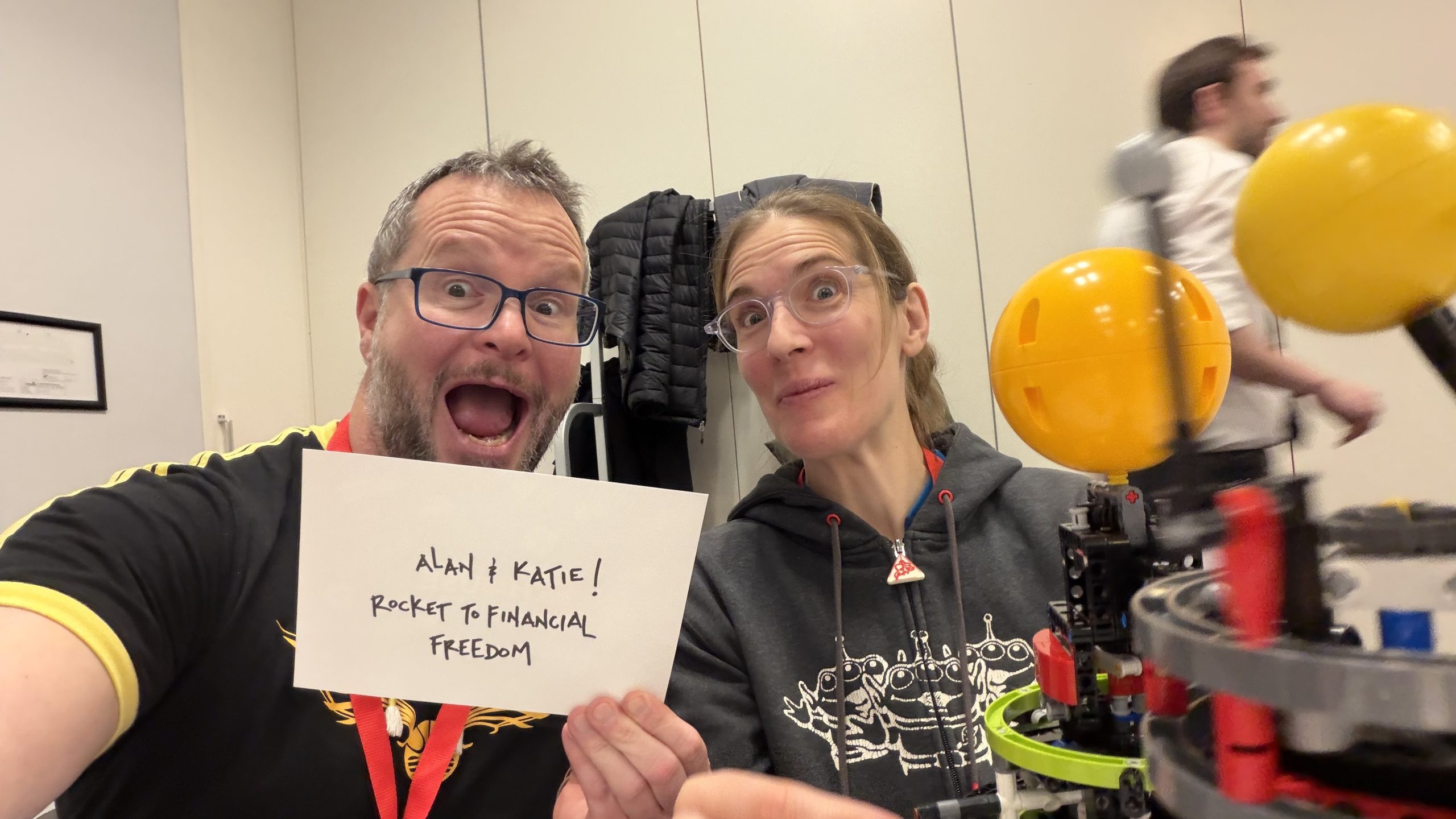
And here’s what we actually managed to build, after two frantic sessions, a lot of teamwork, and a little bit of panic:
The Award Night Ceremony
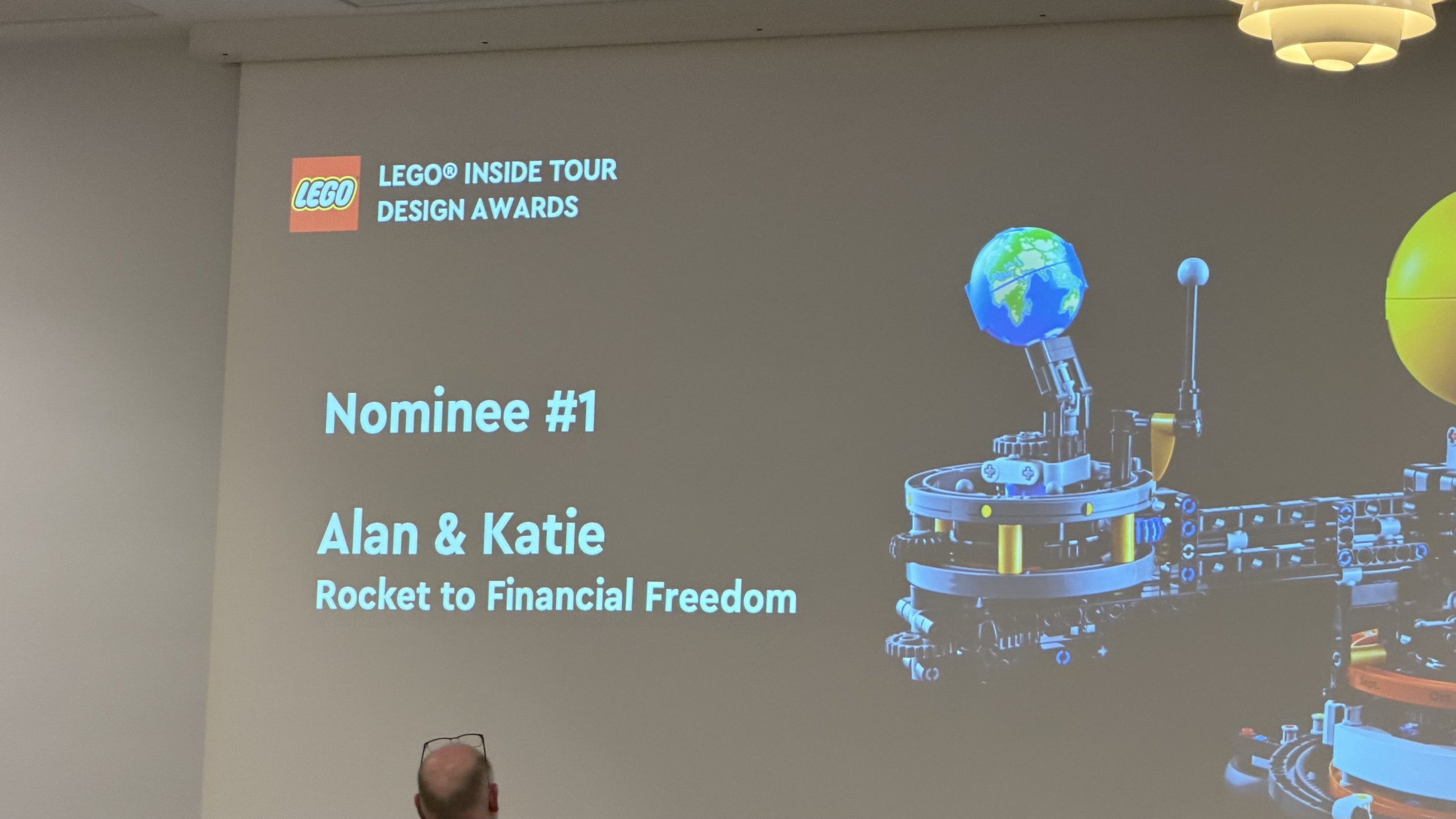
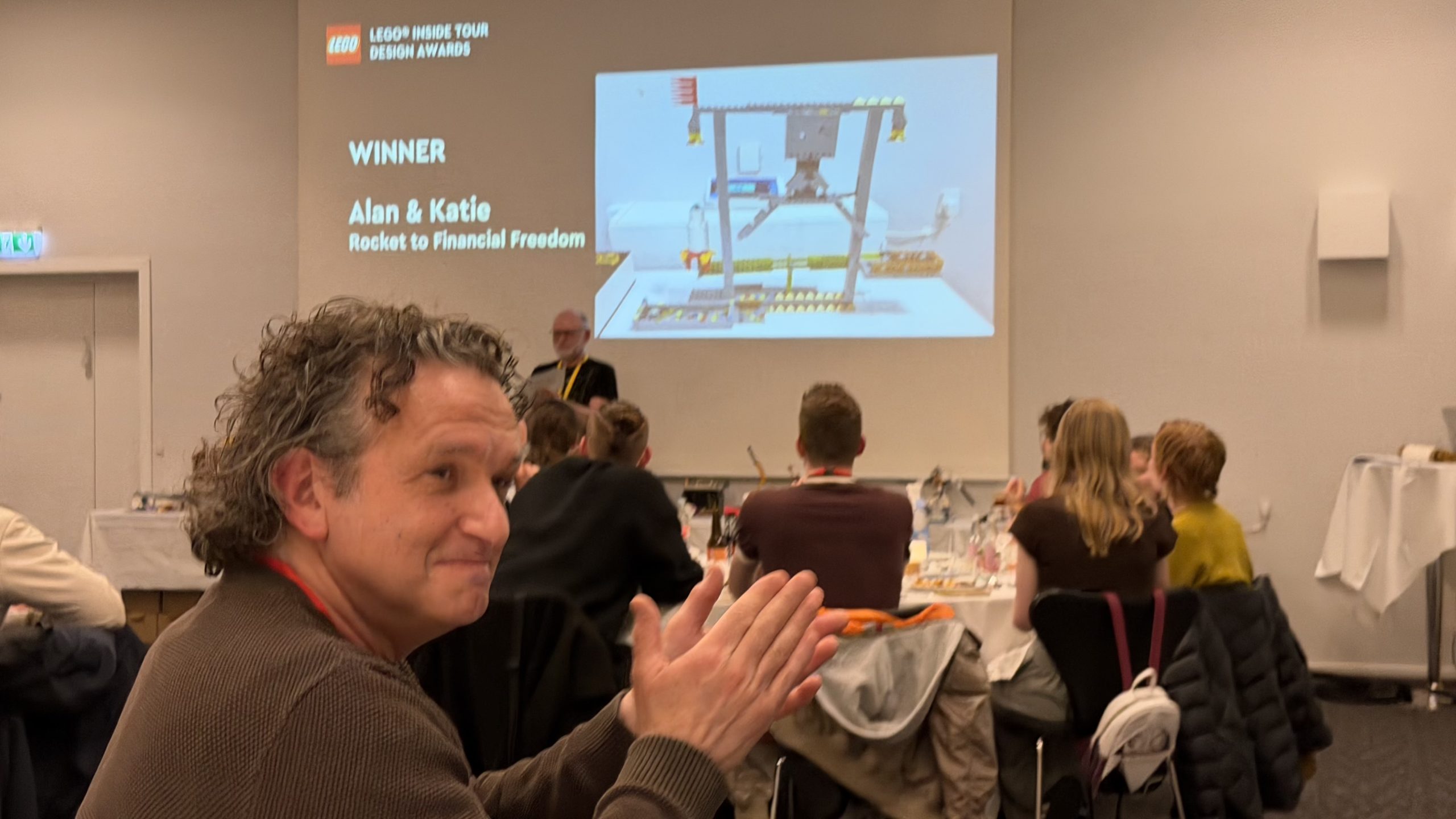
That evening, all the models were lined up for judging. The room was buzzing, everyone was exhausted but excited to see what we had all created. After a quiz and then dinner the judges announced the awards and we all held our breath.
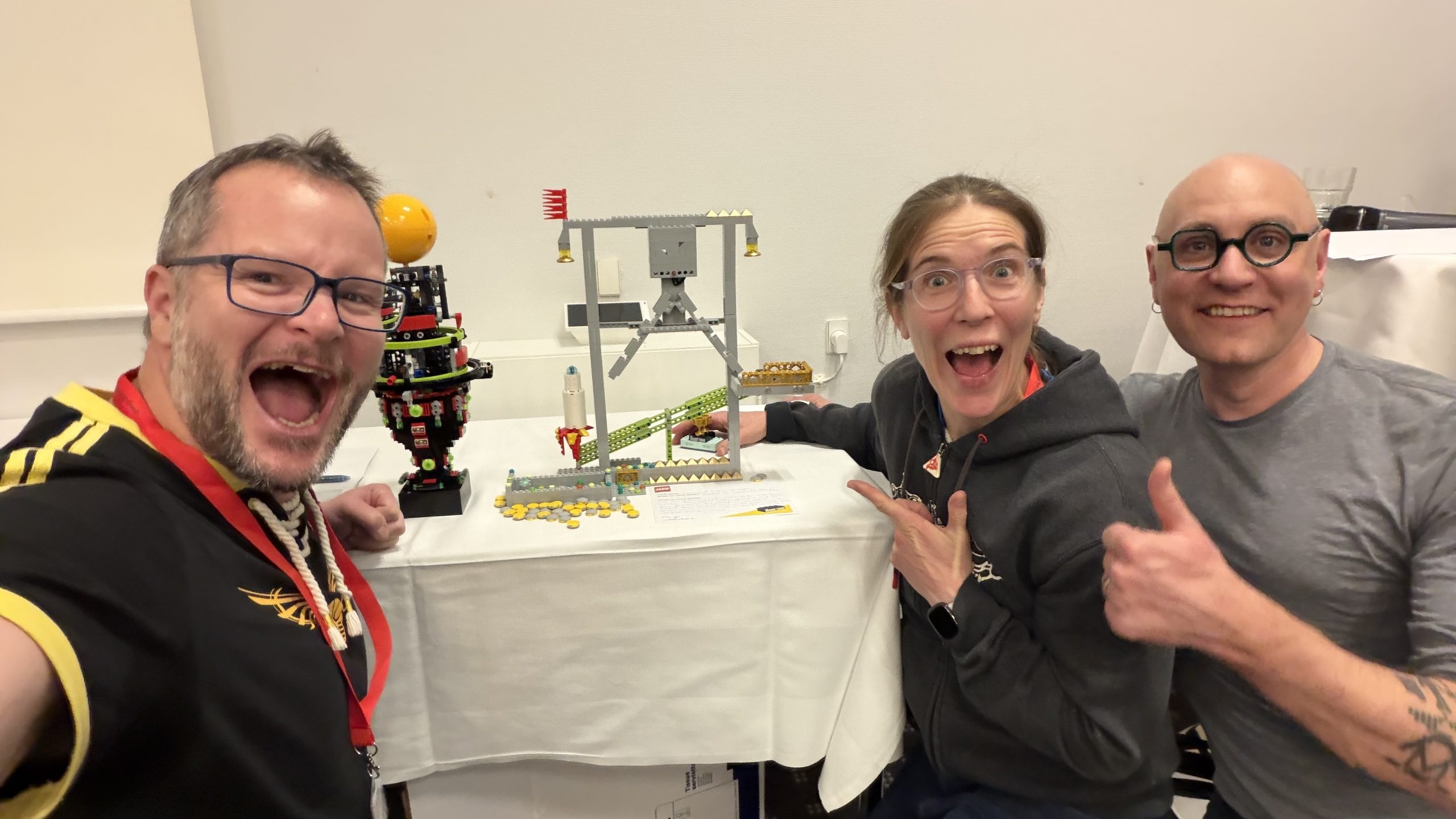
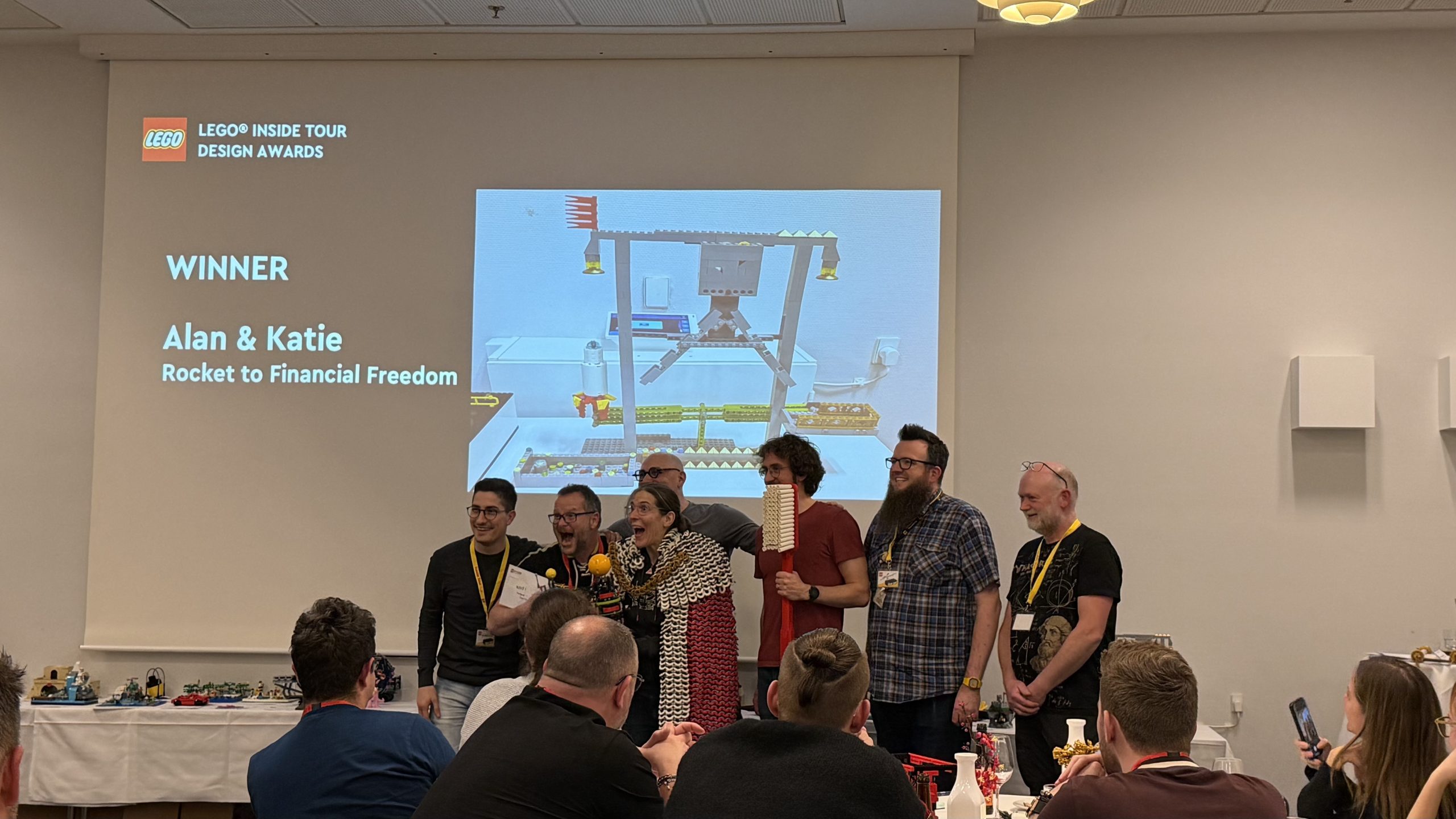
To our shock and delight, our Rocket to Financial Freedom won the Awesome Function prize! The judges loved the way the coins dropped into the basket and triggered the rocket launch. It wasn’t the prettiest model in the room (probably not the prettiest model ever!), but it worked and it told a story.
Even now I can’t believe we won an award for our model. The designers read out a scroll and knighted us with a giant Lego tooth brush in a Lego cape!
What an amazing evening. But the award an the fun aren’t the point of this article.
Why this matters far beyond LEGO
The real point of this story isn’t that we won a trophy in Denmark (though that was very cool). It’s that teaching kids about money doesn’t have to be boring, abstract, or scary.
When you make money visible, when you let kids see, touch, and play with the ideas of earning, spending, saving, and investing, it suddenly makes sense. It becomes a game, a challenge, a story they can build themselves.
And maybe, just maybe, that’s how we help the next generation grow up confident, curious, and unafraid of money.
Maybe we can take the ideas of Rebel Finance School and build models, games like volatility training and more to inspire people. We all love to learn in a practical hands on fashion. yes you need to share ideas, communicate concepts but maybe we can bring it to the next generation in a way that really gets the concepts across whilst playing?
Over to you
So now we want to ask you:
What do you think is the best way to teach kids about money?
- A game?
- LEGO?
- Pocket money?
- Stories?
- Real-life practice?
- Something else entirely?
We’d genuinely love your ideas. Because this little LEGO experiment in Billund feels like the beginning of something.
Maybe together we can build cool things to inspire more people?
19 Comments
Leave A Comment
Related Articles

Blog, Financial Independence, Save and Invest
Where do I put my money? Hello there! We wrote this article in 2025. Platform fees in the UK have changed a lot since then! Look out for an updated article coming soon.....With such a confusing array of platforms, funds and fee structures how do you ever decide where to put your money? In [...]

Blog, Donegan Update, Keeping Track
5th Jan 2026 At the end of the year, Katie and I always get excited because this means a chance to do our annual finance review! How often do you review your finances? Do you check daily, as some people do when they first find out about investing, or are you a set it [...]

Blog, RFS2025, RFS2026
After every single Rebel Finance School session in 2025, Katie and I sat down and wrote notes about what we could improve for next time. We had a lot of ideas. But here’s the thing we’ve learned the hard way over the years: our ideas are not as important as what actually works for real [...]

Alan and Katie, This is Genius! On Easter Sunday I started a Lego set with my adult son who suffers from mental illness. He hadn’t built Lego since he was a child at home. It was fascinating to watch him quickly decipher the directions and find even the tiniest piece we needed. I always chat with him about leaning how to save money, but until now I haven’t had much success. I would love to see a physical Rocket to Financial Freedom kit in the future! Just think of all the adults it could help! They could finally “touch bricks” to reach FI!
Robin, it really does bring you together building a set with someone else and it is such a physical fun thing. I am so happy you did that together on Easter Sunday! Happy Easter! It would be really cool to build a model that would help people!
Absolutely brilliant and a great insight to get younger kids onboard… time to learn one of the AI tools to build an APP?
Real life practice is unbeatable… getting kids to save before they can spend…
Whats an APP Dom? I would have to learn that. Thanks for reading and you are so right, the real life hands on stuff is so important! Alan
All kids are into sweets,
Use sweets and chocolate to perform an exchange or transaction with.
Example, Use 1 sweet/chocolate bar as a long term investment and it will grow into a whole selection box.
Example, An Advent Calendar, certain transactions are done on certain days in order, the door is waiting to be opened to reveal the sweet.
It can be numerous things that children relate and respond to be able to memorise it easier, sweets/chocolate motivates them.
Antonio, love that idea. And if they leave their sweets invested they get more sweets later. You could build a whole system out of that and run a one day workshop at schools! Love it. Alan
sweets obviously being chocolate covered coins then!
What other option is there Ellen! lol. I still look at Chocolate covered coins in the shops! am I still allowed them as an adult! lol. Thanks for reading. Alan
All children are different and learn in different ways. So I think all of the above and more. More important is the concept and the tone it’s delivered in, not patronising but level appropriate (not necessarily connected to age) . Also shorter more interactive “lessons”
Hey Cassie, you are so right, speaking directly to children and connecting and treating them like equals is so important. Thank you. Alan
I absolutely love this idea. LEGO is such a brilliant way to teach kids about money because it makes everything feel fun, visual, and hands on instead of confusing or boring.
I also think topped with real-life experience would be so valuable, as the extended hands on experience will also help children learn and remember things.
Alan and Katie you both have done a fantastic job with this. The Rocket to Financial Freedom is such a creative and inspiring idea, and you can really see how much passion went into it.
This would be a great way to help children build confidence with money from an early age.
Hey Nina, yes doing a hand on experience would be amazing where they play and have fun and we teach them the ideas at the same time, or it is an after school club that learns through doing it. Thanks for writing back and telling us! Sending you happiness… Alan
You’ve probably seen it, but might be a good way to also introduce the Serious Play concepts, whereby Lego is used as part of workshops for participants to solve certain problems https://seriousplay.training/lego-serious-play/
Robbie! we owe you a date to chat and I LOVE serious play. it is amazing and my business partner Simon is trained to deliver it and we have delivered a lot of sessions together. it is AMAZING…
This is fantastic! So visual and it gets you “doing” too. I think that reinforcing these concepts from all sides (stories, apps/games and, interactive roleplay – moving along the passive to active scale!) is the way to go. It allows for spaced repetition, as well as different learning styles. And honestly, it would work for adults as well as kids. Kids act out shopping scenarios in primary school where they are the shop keeper, or they are buying something. At some point they know they need to hand over money to get what they want. I don’t see why a slightly more complex version of this couldn’t be created that kids in Year 5 or 6 could understand. Then you could raise the complexity level for secondary school. I think it would provide a very welcome and incredibly useful core life-skill addition to PSHE! In 6th form, it could be even be a competition to see who could end up with the most wealth based on decisions made – like a real-life board game or maybe something more escape-room style to engage the “cooler” kids. (Sorry, stream of consciousness as ideas are bubbling up!!) I’d love to see something like this at my son’s school though. I think we all learn best by DOING – that’s when it really goes in.
Hey Tania, I love your ideas. I used to run inset day workshops for kids and LOVED doing it. Travelling round the country running sessions getting kids to play games and do! it was so much fun. I love your ideas! Alan
Amazing use of lego! I think giving young kids small amounts of pocket money to manage, perhaps for doing a few household chores, is important. Encouraging them to get into the habit of saving some pocket money from a young age is a key positive habit which can be built on when they’re older with more detailed knowledge about debt, investing etc. I think younger kids are reasonably receptive to their parents trying to teach them how to manage money. It’s much harder with teenagers who often want to rebel against parents, are striving for independence and are more influenced by peer pressure. Hopefully that changes as they get older and see the parents lived example. Personal finance education still seems totally inadequate in school, from what mine have said. I wonder if 6th form/college would be a good time to teach personal finance?…although some have left education by then. I think given how many people including me say “I wish I’d known about this when I was younger” I think we should, as a society, be doing a lot more to educate our kids! Martin Lewis has produced resources for schools but not sure what the uptake is. Thanks for all you do
Love the Rocket launcher! I am PASSIONATE about Teaching kids about money. ( people call me ‘The pocket money lady’. I have written a ‘pocket money guide’ for parents and have spoken to parent groups. My biggest point is to encourage parents to give kids money as a learning tool, ( consistently) as opposed to making them earn it by doing jobs. ( unless they want to extend their ‘gap’ by doing extras that the parents are willing to pay for, like washing cars/ mowing lawns). Happy to share my book! From there I encourage them to split into: share/ save/ spend. For older kids, I have purchased ‘The money game’ where students are part of the game.
Anita — “the pocket money lady” is an INCREDIBLE title. We love it.
I LOVE how passionate you are about this. Money as a learning tool is a fascinating distinction and then adding in increasing the gap by earning more is interesting. Love it.
Share / save / spend is simple and powerful. LEGO, money games, parents actually talking about this stuff, all of it counts. What is The Money game you reference? Tell us more about that. Would love to know more about what you are working on and your plans…
Thank you for doing this work and for jumping in here to share. Peace and Pineapples.
Alan & Katie