

How do I actually start investing?
This is the week where we take investing out of the scary finance fog and bring it back down to earth. No jargon Olympics. No shame. No pretending you should already know this.


Week 6 TLDR
The simple version before your brain starts shouting
Investing can feel like being dropped into a foreign country where everyone speaks fluent spreadsheet. This week is the phrasebook. You do not need to be fluent today. You just need to start recognising the language.
You may already be an investor
If you have a pension, 401(k), KiwiSaver or similar account, you may already own investments. The plot twist is that nobody may have explained what is inside.
Default is not a strategy
A default fund might be fine, but only if you consciously chose it. If it just happened while you were busy living your life, it is time to investigate.
The stock market is the asset shop
Shares are not magic beans. A share is a tiny slice of ownership in a real business that sells real things to real people.
There are three main ways to invest
You can pick businesses yourself, pay someone else to pick, or stop picking and buy the whole haystack through index funds.
Risk and volatility are not the same
Volatility is the price wobbling. Risk is losing money over the long term. Mixing those up is how clever people make very expensive decisions.
Hold your horses
Please do not panic-change your pension at 11:47pm with nineteen tabs open. Learn first. Gather the facts. Then make informed decisions.
Jump to the bit you need most
Quick diagnosis
Do I need this week?
If investing makes you want to close the laptop, make tea and pretend pensions are not real, you are not broken. You are under-trained. This week is for anyone who wants investing to feel simpler, safer and less like a secret club for people in expensive shoes.
If one of these sounds like you, stay with us. One tiny step is enough.
I have a pension, but no idea what is inside it
This is incredibly common. The first job is not to fix it. The first job is to find it, name it and understand it.
I accepted the default fund
Default might be fine. But if you did not consciously choose it, it is not your strategy. It is just what happened.
I picked random funds because the names sounded sensible
No judgement. Many clever people have done the same. Random is not a plan, but it is fixable with education.
I think the stock market is gambling
Some people use it like a casino. That does not mean the stock market is a casino. This week shows the difference.
I am scared I am not clever enough for investing
You do not need to become a fund manager. You need enough understanding to make calm, informed decisions.
I am in debt, building an emergency fund, or close to retirement
This can still matter. You may already have pensions or investments that need understanding, even if you are not ready to add new money yet.
Your job this week is not to become Warren Buffett in a cardigan
Your job is to stop drifting, gather the facts, learn the language and take one calm step towards understanding what your money is doing.
Freedom Work
Find what you already own
This week is detective work, not panic work. Before you change anything, gather the facts. Future you does not need dramatic midnight pension surgery. Future you needs clear information.
Hold your horses
Do not make big investment changes yet. We are still building the foundations. This tiny action is about understanding what you already have.
If you have pensions or stock market investments
Open the portal, statement or paperwork and write down what you can find. Messy notes are better than beautiful avoidance.
If you own investment property
Property can be brilliant, but it is not automatically brilliant. We need to know how hard that money is actually working.
If you cannot find everything, that is still progress
The win is not completing a perfect spreadsheet. The win is breaking the spell of avoidance. Find one login. Open one statement. Write down one fund name. The spreadsheet is not disappointed in you.
Useful links for this tiny mission
Use these to orient yourself, ask for help and take the default fund poll.

Tiny but important disclaimer
This is education, not financial advice
We are not financial advisers. We are not regulated. We are not here to sell you investments or tell you what to do with your money. We share education, examples, opinions and what has worked for us.
Investments can go down as well as up. You are responsible for your own decisions, and a little bit of knowledge is a dangerous thing. Learn first. Gather the facts. Then make calm, informed choices.
First big reframe
You might already be an investor
Lots of people arrive at Week 6 thinking, “I am not ready for investing.” Plot twist: if you have a pension, 401(k), KiwiSaver or similar account, you may already be investing.
That does not mean you are behind. It means responsibility may have been handed to you without anyone stopping to teach you the language.
Auto-enrolment and workplace retirement schemes mean many people are automatically added to a pension or retirement account through work. In the UK this might be a workplace pension. In the US it might be a 401(k). In New Zealand it might be KiwiSaver. Different countries use different names, but the pattern is similar: money goes in, investments are chosen, and suddenly future you is depending on choices you may never have been properly taught to understand.
This is why investing can feel scary. It is not because you are stupid. It is because the system gave you responsibility without giving you a proper map.
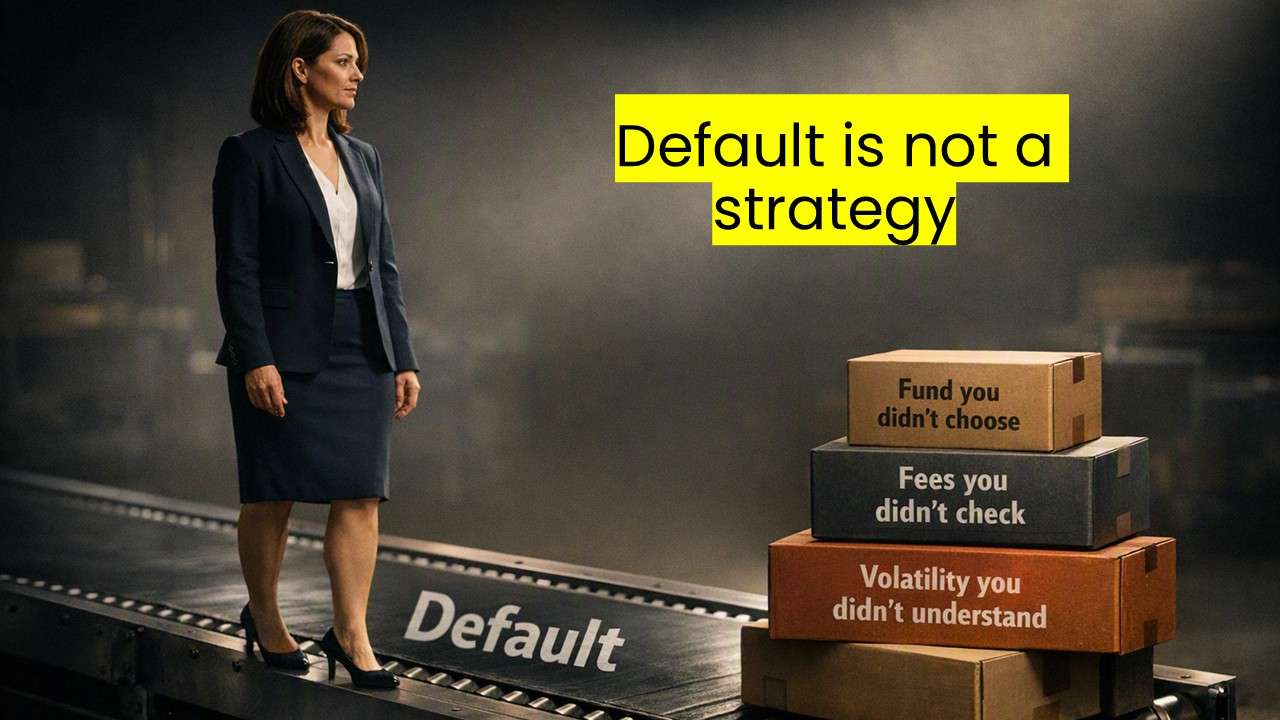
Default is not a strategy
A default fund might turn out to be fine. But if you have not consciously chosen it, understood it or checked the fees, it is not your strategy. It is just what happened while you were busy living your life.
Default often feels safe because it was chosen by a provider, employer or system. But “someone put me there” is not the same as “I understand why this is right for me.”
Our job is education. Your job is decision-making. We can explain what worked for us, show you examples, help you understand the moving parts and point you towards useful questions. But nobody gets to press the big financial buttons for you. Not us. Not a bloke in a shiny suit. Not a random article on the internet.
The first win is not changing your fund
The first win is finding out what fund you are already in, what it costs, what it invests in and whether you consciously want to keep it. No shame, just data. Your numbers are not judging you.
Get that money working for you!
Your money needs a job
For the first five weeks of Rebel Finance School, we have been building the foundations. Now we start putting your money to work for future you.
Week 5 was all about communication and alignment. Money is not just numbers on a spreadsheet. Money is a tool to build the life you want. No one cares about the spreadsheet until they know what life it is helping to build.
Week 6 is where the money starts getting a job. The gap you create by spending less than you earn is the fuel. Investing is how that fuel starts working for your freedom.
Your why gives direction
This is the life you are building, not someone else’s financial checklist.
Your gap creates fuel
The money between income and spending gives you choices, breathing room and momentum.
Your Freedom Fund buys freedom
Investing is where some of that money becomes little workers building future options.
At first, your gap might go towards a starter emergency fund, paying off expensive debt or building proper financial breathing room. That still matters. We are not telling everyone to sprint off and invest today.
But here is the twist: even if you are not ready to add new money to investments yet, you may already have money invested through a workplace pension, 401(k), KiwiSaver, SIPP, ISA or another retirement account.

Is your money actually working for you?
Some money is out there quietly owning assets, earning returns and building future freedom. Some money is lazing around doing very little, possibly in cash for too long, expensive funds, a default option you never chose or an investment you have not reviewed for years.
The goal is not to make money frantic. The goal is to give it a useful job.
Lazy money
Money that is not earning much, costs too much to hold, or is sitting in a fund you did not consciously choose.
Working money
Money that is intentionally invested in assets that can grow, produce income and help buy back your time.
This week is not about becoming a trader. It is not about staring at charts. It is not about getting thrills from the stock market. If you want entertainment, go to the cinema. Your investments are there to look after future you.
The question for Week 6 is simple: is your money actually working for you?
One tiny next step
Before you judge, change or panic about anything, find out what you already own. Provider, account, fund name, fees and factsheet. That is enough for now.
Assets and liabilities
What can your money buy?
If your money needs a job, the next question is obvious: what do you actually send it out to buy?
This is where we use the simplest possible definition. We are not trying to impress anyone with finance language. We are trying to work out whether something helps buy your freedom or keeps nibbling away at it.
Asset
Owning something that earns you money.
Liability
Owning something that costs you money.
That definition cuts through a lot of noise. A thing can be valuable, shiny, exciting or impressive and still not be doing the job of an asset. The question is not “can I sell this one day?” The question is “does this help produce income or growth that can support future me?”
Want Alan’s deeper dive on assets?
Read the full article on what you can do with savings, property, stocks and shares, index funds, cash and other investing options.
For the rest of this session, we are mainly focusing on businesses, shares and index funds. Not because nothing else exists. Not because property is automatically bad. But because globally diversified index funds are the simplest, most scalable Freedom Fund engine we know.
What are we looking for in a good Freedom Fund investment?
We like things that can work without constant attention, do not cost a fortune to own, are reasonably simple to manage, can be held tax efficiently, and can scale from small amounts to large amounts.
The asset shop
What is the stock market, without the scary stories?
When Alan first learned that assets bought freedom, the obvious next question was: “Brilliant. Where is the asset shop?”
You can walk down the high street and find a coffee shop, a Greggs, maybe a betting shop and somewhere selling phone cases. But there is no shop with “Assets” written above the door and a cheery assistant saying, “Morning, would you like two bags of freedom and a small dividend with that?”
That confusion matters. If people do not know where assets come from, the whole idea of “make your money work for you” stays vague. And vague money ideas are hard to act on.
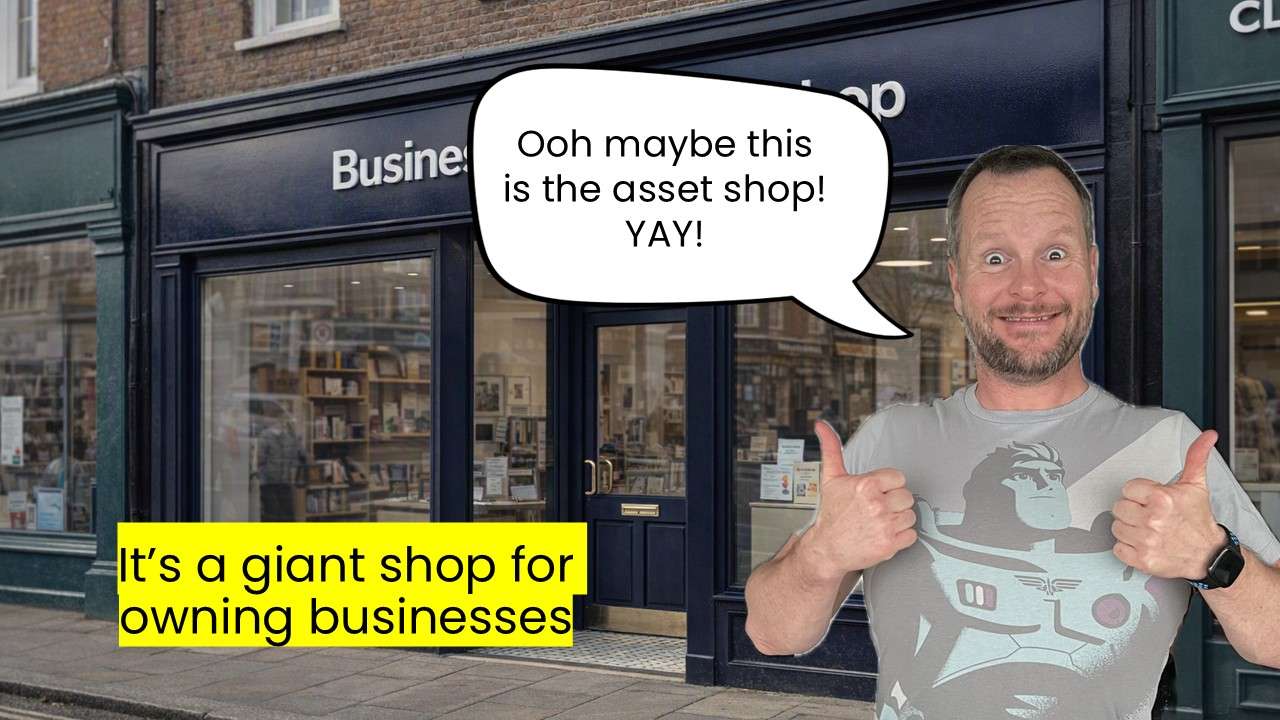
The stock market is a giant shop for owning businesses
The stock market is not just flashing numbers, confusing charts and shouty finance people on television. At its simplest, it is a marketplace where people buy and sell slices of businesses.
When you buy shares, you are buying ownership. Tiny ownership, yes. Probably not enough to storm into Apple and demand better biscuits in the boardroom. But ownership all the same.
This is the emotional shift we want for Week 6. The stock market is not a mysterious casino in the clouds. The casino version exists because some people use it that way. But underneath the panic, noise and movie scenes, there are real companies.
There are supermarkets, software companies, factories, insurance companies, retailers, transport businesses, healthcare companies, app companies and thousands more. They sell useful things. They receive money. They pay costs. If there is money left over, that is profit.
The movie version
Crashes, gambling, shouting, suits, cocaine, panic and people pressing dramatic buttons.
The family story version
Great Aunt Mabel lost her life savings, so the whole stock market gets filed under “absolutely not”.
The useful version
A giant shop where you can buy ownership in real businesses that sell real things to real people.
Once you see the stock market as a shop for owning businesses, the fear can start to shift into curiosity. The question becomes less “What terrifying finance monster is this?” and more “Which way of buying businesses gives ordinary people the best chance?”
That is where we are going next.
Key idea
A share is not a lottery ticket or a magic bean. It is ownership of a tiny slice of a business. The next step is understanding how that ownership can make money.
Choosing what to buy
There are three main ways to invest in the stock market
Once you understand that shares are tiny slices of businesses, the next question is: which businesses should you own?
This is the part where the finance industry often makes everything feel complicated. It does not need to start there. Broadly speaking, there are three doors.
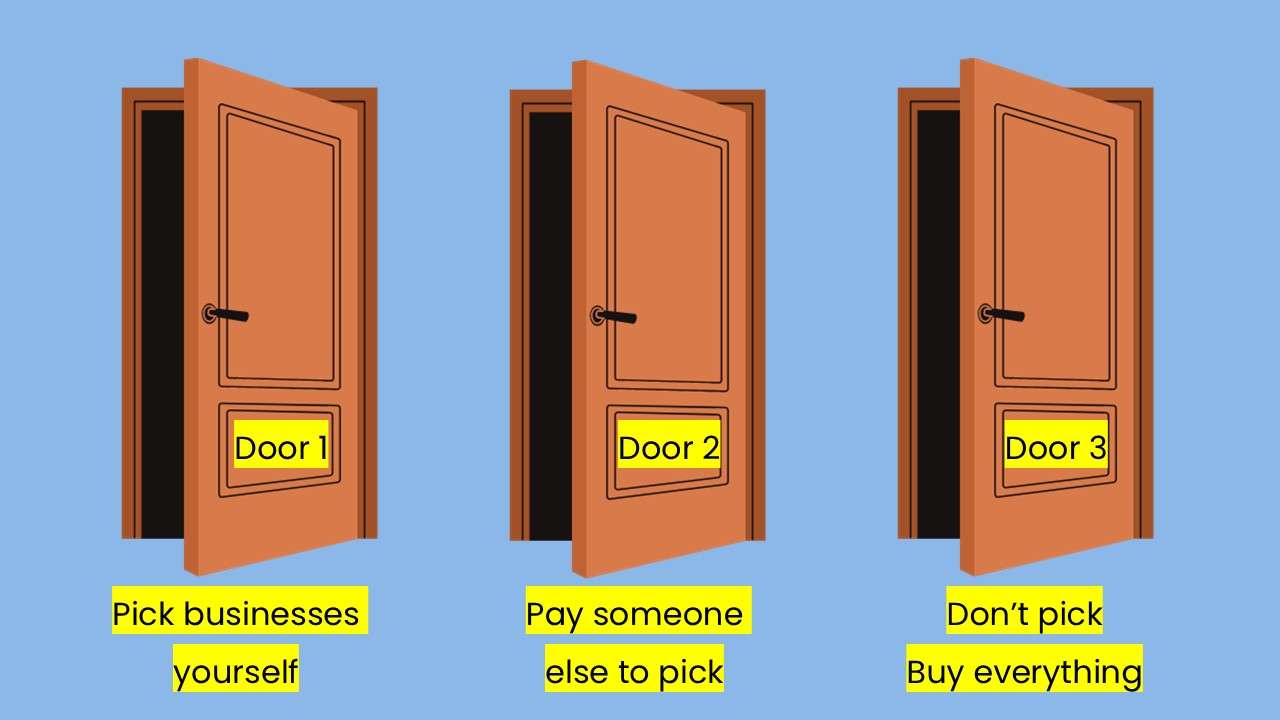
The whole investing choice in one picture
You can try to pick the winning businesses yourself. You can pay someone else to try to pick them for you. Or you can stop trying to pick winners and buy the whole haystack through low-cost index funds.
This does not answer every practical question yet. It gives people a clear map before heading into the details.
Pick businesses yourself
This is when you choose individual companies. “I like Disney,” “I use Apple,” “I think this company will win.”
The problem is concentration. One business can do badly. One business can fail. This is where diversification matters.
Useful question: am I investing, or am I guessing with confidence?
Pay someone else to pick
This is active investing or managed funds. A fund manager, adviser or wealth company tries to pick winners for you.
This usually comes with higher fees, clever-looking reports and a lot of confidence. Later, we will look at why this is such a hard game to win after costs.
Useful question: are the fees buying skill, or just buying a shiny story?
Do not pick. Buy everything.
This is index investing. Instead of hunting for the winners, you buy a broad list of businesses and accept average market returns.
Average does not mean mediocre. It means the average of the businesses in the market, which most active funds struggle to beat over time.
Useful question: what if the boring option gives ordinary people the best odds?
Do not look for the needle. Buy the haystack.
This is the idea that changed investing for us. Instead of trying to predict which company, country, sector or fund manager will win, you can own thousands of businesses through a diversified index fund.
That is why the next few sections build towards diversification and index funds. First we reduce the need to guess. Then we show how buying the whole market works in practice.
Deep dive: diversification
If Door 1 makes you think, “I do not want all my eggs in one basket,” this article explains the idea in more detail.
Read about diversificationDeep dive: index funds
If Door 3 sounds interesting, this article explains what an index fund is and why it can be so powerful.
Read about index fundsDiversification
Do not bet the farm on one chicken
The moment people understand shares, the next fear often arrives: “How am I supposed to choose the right company?”
Good news. You do not need to build your entire future around one company, one boss, one industry, one country, one hunch, one hot tip, or one chicken with suspiciously confident feathers.
Owning one business
If that business has a terrible decade, you have a terrible decade. If that business fails, your investment can disappear. That is concentration risk.
Owning lots of businesses
Some businesses will win. Some will lose. Some will become enormous. Some will quietly fade away. You do not need to know which one will be which.
Diversification is spreading your money across many investments so one bad outcome does not wreck the whole plan. It is the financial version of not putting all your eggs in one basket, one handbag, one wheelbarrow, or one emotionally unstable chicken coop.
This is why picking individual stocks can feel exciting but can also be brutal. If you pick the next Apple, brilliant. If you pick the next company that disappears into the corporate swamp, less brilliant.
The huge relief: you do not have to be a stock-picking genius
One of the biggest breakthroughs in our investing journey was realising that we did not need to become clever stock pickers.
We thought successful investors were people sitting in front of six screens, drinking alarming amounts of coffee, reading annual reports for breakfast and spotting hidden opportunities before everyone else.
Then we discovered a much calmer idea: instead of trying to find the winning needle, buy the whole haystack.
That is the path that eventually led us towards low-cost global index funds.
Company risk
One company can fail, get disrupted, get badly managed, get sued, or just have a terrible few years.
Sector risk
One industry can boom and then suffer. Technology, property, energy, banking and healthcare all have their own cycles.
Country risk
One country can underperform for a long time. A global approach reduces the need to bet everything on one place.
Diversification does not mean every investment goes up all the time. It means you are not relying on one prediction being right. You are building a portfolio that can survive some wrong calls, some bad years and some businesses not making it.
That survival matters because the investor who survives gets to keep compounding. The investor who goes all-in on the wrong thing may not get another go.
Key idea
Diversification is not about looking clever. It is about reducing the damage of being wrong. And everyone is wrong sometimes.
Want the deeper dive?
Read our full guide to diversification and why putting all your eggs in one basket is not the most relaxing retirement plan.
Index funds
Buy the whole haystack
Diversification is the relief. Index funds are one of the simplest tools for actually doing it.
An index fund is a fund that buys lots of investments by following a list, or index. Instead of one person trying to pick the winning companies, the fund tracks a market and buys the companies in that market.
That is why index funds can feel boring at first. Nobody is wearing a dramatic waistcoat on television shouting, “I have discovered tomorrow’s winner!” The power is that the fund does not need to discover tomorrow’s winner. It owns the market.
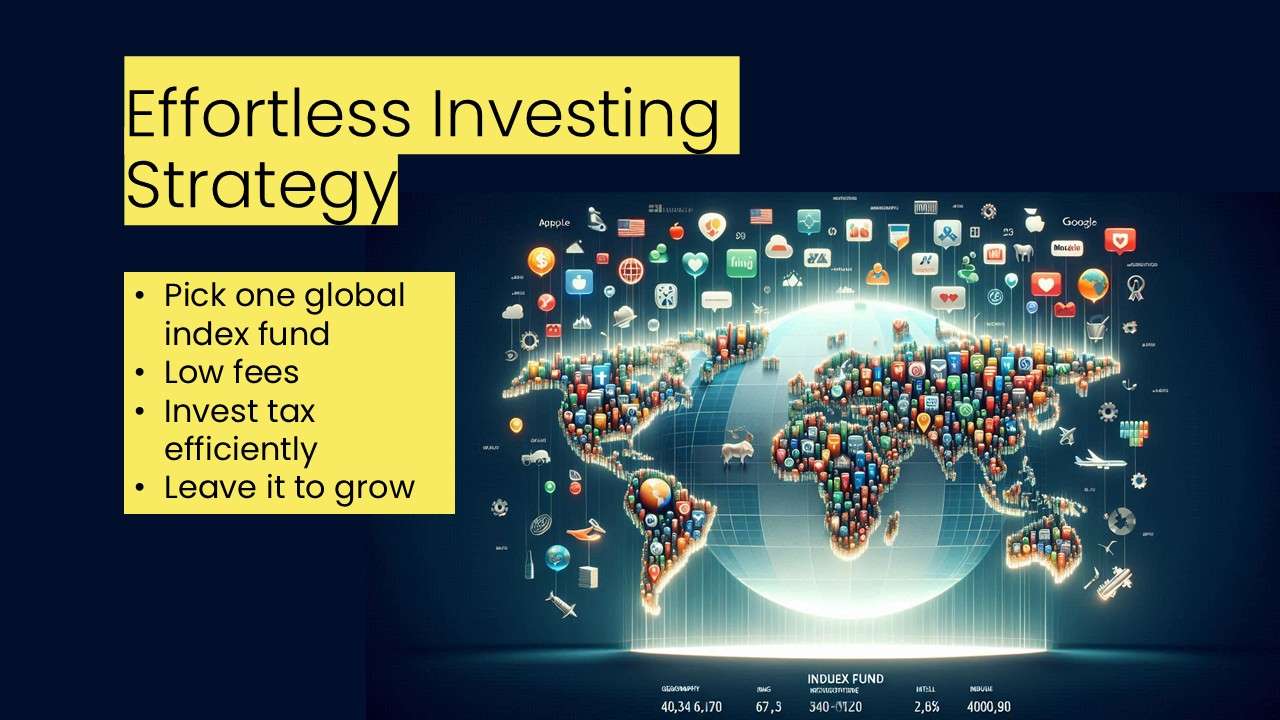
The Donegan direction of travel
Our preferred approach is simple, low-cost, globally diversified index investing. Not because it is flashy. Not because it makes us sound clever at dinner parties. Because it gives ordinary people a practical way to own tiny slices of thousands of businesses.
This is the opposite of trying to guess the one big winner. It is choosing to participate in the growth of many businesses over a long time.
Low cost
Because the fund is tracking an index rather than paying a team to constantly pick and trade, fees can be much lower than many active funds.
Diversified
A global index fund can hold thousands of companies across countries, industries and sectors.
Simple to manage
Simple does not mean effortless forever, but it can massively reduce the number of decisions you need to keep making.
The quiet revolution
Index funds helped democratise investing. The basic idea was radical: instead of needing a clever person in a suit to pick investments for you, ordinary investors could buy the market at low cost and receive a fair share of market returns.
This is why Jack Bogle and Vanguard come up so often in the investing world. The mission was to make investing fairer and lower cost for ordinary investors. That idea is deeply aligned with the Rebel Finance School spirit.
We are not sponsored by Vanguard. We do not receive commission from them. We talk about them because we have used their funds ourselves and because their original mission helped change the investing world.
The emotional shift here is huge. You do not need to become the person who knows which company will win. You do not need to watch markets every morning. You do not need to turn your life into a second job called “portfolio wizard”.
You need enough understanding to choose a sensible strategy, keep costs low, stay diversified, and then let time do a lot of the heavy lifting.
Key idea
An index fund can let you own thousands of businesses in one fund. One fund does not necessarily mean one investment. It can mean one wrapper around a huge basket of companies.
Deep dive: what is an index fund?
Read the full Rebel Donegans article if you want Katie’s charts, examples and the longer explanation.
Read the index fund guideDeep dive: what can I do with savings?
This article covers the wider investing landscape, including property, stocks, index funds, cash and Alan’s early mistakes.
Read the assets article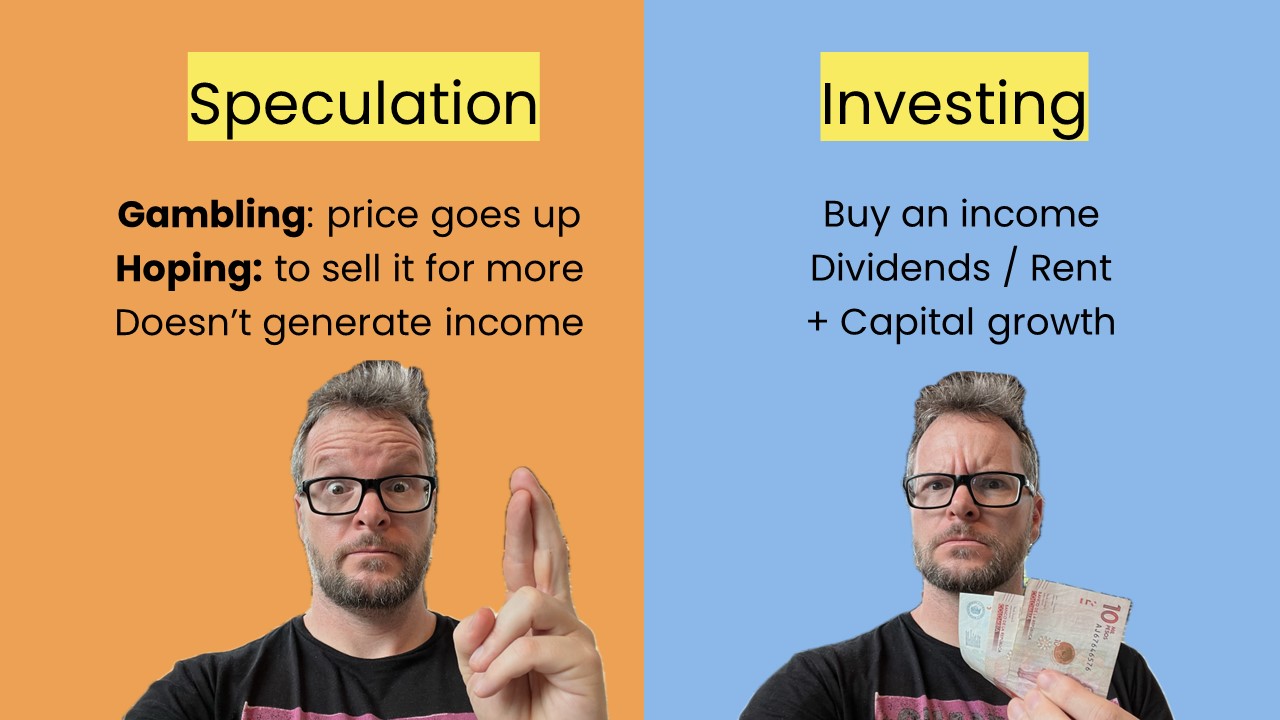
Speculation
This brings us onto a SUPER important distinction which is speculation versus investing. Speculation is buying something (gold, art, Lego) and hoping to sell it later for a profit. It is a risky business.
Investing is buying an asset that is proven to bring an income with it. So you buy a business (shares) or rental property that give you a return as well as the possibility of capital appreciation (they go up in value)
Long term wealth is created through buying income producing assets. That is what we (Katie and I) worked on for years to create the returns we needed to be able to stop working.
📊 How Do You Invest in the Stock Market? (Without Losing Your Mind or Your Shirt) 👕💸
We get asked this all the time — and for good reason. The stock market can feel like a chaotic jungle of jargon, flashing numbers, and men shouting into phones. But don’t worry — we’ve tamed the beast for you 🦁📉
🎥 We made a video to explain it all — but here’s the TLDR:
There are 3 main ways to invest in the stock market:
🎯 1. Stock Picking
Pick individual companies and hope they go up.
Sounds exciting? It’s basically gambling with a spreadsheet.
Risky, time-consuming, and statistically not great. 🎲📉
💸 2. Managed / Active Funds
Pay someone else to pick stocks for you.
They charge high fees, and most of them underperform the market.
Expensive and meh. 🧓💼💸
🌍 3. Index Investing (Our fave!)
Buy every company in a market through a low-cost index fund. No guessing. No stress. Just steady, diversified growth.
Simple, powerful, and Donegan-approved. ✅📈
The video above gives you a short recap of the 3 ways to invest in the stock market and the video below, what is an index fund has animated charts from Katie showing you what is inside an index fund.
🧠 The Donegan Strategy: Keep It Simple, Keep It Smart
We invest in index funds, specifically Vanguard ones. Why?
- ✅ Low fees
- ✅ Easy to buy
- ✅ Globally diversified
- ✅ Leaves us more time for living life, not watching stock tickers
We’re not sponsored by Vanguard — we just love what they do. Our go-to funds are:
- Vanguard FTSE Developed World ex UK
- FTSE Global All Cap
We hold them in tax-advantaged accounts like ISAs and SIPPs — don’t worry if that sounds like alphabet soup right now. We’ll break it all down in the coming weeks 🍜📚
🎥 Want to see what an index fund actually is?
We made a video for that too — complete with animated charts and Katie’s magic visuals. Check it out and get ready to fall in love with boring investing 💖📊
I’m a visual learner, is there a way I can see what an index fund is?!
I’m glad you asked! Katie has made you a beautiful chart so you can see what an index fund is at a glance. Each box represents a different company in the index. Each colour is a different country. We’re not choosing an individual company, country or industry. We’re choosing every investable company in the world. We’re “betting” on the world economy continuing to do well.
this visual works best on bigger screens, hook your laptop up to the television, put it on the big screen and have fund looking through the visual!

Feeling keen?!
In the height of lock down in 2020 Katie and I wrote an investor series to explain index funds and investing. Here are three articles to accompany this weeks course for you.
⚠️ Risk vs Volatility: The Most Misunderstood Duo in Finance 🎭💸
The financial industry has done a spectacularly bad job of explaining this — and it’s one of the most important distinctions you’ll learn in this course. Seriously. If you only remember one thing from Week 6, make it this 👇
🧠 Volatility ≠ Risk
- Volatility = How much your investment wiggles up and down in the short term 📈📉
- Risk = The chance of losing money permanently 💀💸
The stock market goes up and down all the time — that’s volatility. But if you panic and sell when it’s down? That’s when you turn volatility into actual loss — aka risk.
🎯 Why This Matters:
This concept is the foundation of our investing strategy. We invest in volatile things (like index funds) because we know:
- Over time, they go up 📈
- We won’t sell when they’re down 🙅♂️
- We’re in it for the long haul 🐢💪
If you confuse volatility with risk, you’ll make emotional decisions, sell at the worst time, and sabotage your future wealth. And we’re not about that life.
📚 Want to go deeper?
Alan wrote an article that breaks this down beautifully — with real-life examples and Rebel clarity.
👉 Click here to read it! (misunderstanding this is one thing is one of the key reasons why people end up skint in retirement.)

🐢 In It for the Long Term (No Get-Rich-Quick Nonsense Here)
Let’s be crystal clear:
This is not a get-rich-quick scheme.
This is a get-rich-slowly-but-sustainably-and-sleep-well-at-night strategy 😴💸
🧠 The Rebel Investing Mindset:
- Buy and hold.
- NEVER sell.
- Don’t panic when the market crashes.
- Seriously — don’t.
Because here’s the truth:
The stock market WILL crash. Not if, but when.
And when it does, your brain will scream: “SELL EVERYTHING!”
But if you listen to that voice, you’ll kill the golden goose 🐔💀
🥇 The Donegan Way:
We invest for the long term — 10, 20, 30+ years.
We ride the rollercoaster 🎢
We don’t jump off when it dips.
We trust the process.
And we let time and compound interest do their thing 🕰️📈
If you can stay calm when everyone else is losing their minds, this strategy will work beautifully.
If you panic and sell when things get wobbly… it won’t.
So buckle up, Rebels. This is the slow, steady, freedom-building path — and it works. 💪🔥

🔮 Coming Up Next: From Theory to Action (and Beyond!) 🎢💼
You might be thinking…
“Alright Donegans, this is all great — I get the theory, I’m pumped, I’ve got my emergency fund… but how do I actually do this investing thing? What account do I open? What fees should I avoid? Where do I click?!”
We hear you. And don’t worry — we’ve got you covered.
This week was all about foundations. You’ve just built the base of your financial fortress 🏰
But we can’t cram everything into one session (unless we all want to be here until Tuesday). So here’s what’s coming up in the next few weeks:
📅 Week 7: The Roller Coaster of the Stock Market
- 🎢 What to expect when the market goes bananas
- 🧠 Volatility training: how to stay calm when your investments wobble
- 💪 Building the emotional resilience of a financial ninja
📅 Week 8: Let’s Get Practical
- 🧾 Tax-advantaged accounts (ISAs, SIPPs, 401ks — oh my!)
- 🛠️ How to actually open an account and start investing
- 🌏 Kiwi Edition with Ruth the Happy Saver 🇳🇿
- 🇺🇸 USA Edition with Brad Barrett from ChooseFI
📅 Week 9: How Do You Know When You’ve Got Enough?
- 🧮 The maths of financial independence
- 🧘♀️ The mindset of “enough”
- 🧭 Creating your own freedom number
📅 Week 10: Sequence of Return Risk
- 🧨 The sneaky risk that can derail your retirement
- 🧠 How to protect yourself so your money lasts as long as you do
- 🛡️ Strategies to make your retirement income bulletproof
📝 Freedom Work: Your Mission, Should You Choose to Accept It… 🎯💼
To get the most out of this course (and to actually buy your freedom), you’ve got to do the work.
Yes, we know — it’s called “homework,” but around here we call it Freedom Work — because every task you complete gets you one step closer to financial independence 🏖️💸
Katie swears it’s fun. Alan says it’s essential. We say: let’s do this.
🔍 1. Investigate Your Existing Investments 🕵️♀️
You might already have money invested — in a pension, a stocks & shares ISA, or a SIPP. But do you know what it’s actually doing?
Create a table (spreadsheet, notebook, napkin — whatever works) and find out:
- 📦 What funds are you invested in? (Get the exact names!)
- ⚖️ What’s the stock:bond split?
- 💸 What are the fees? (Platform fees, AMCs, entry/exit fees — dig deep!)
- 🧠 Are they active or passive?
- 🔄 What other funds are available to you? (Can you switch?)
This might take some detective work. You may need to call your pension provider, dig through paperwork, or decode a fund factsheet. But trust us — this is critical to taking control of your financial future. These people work for you. Don’t let them off the hook.
🏠 2. Own Property? Time to Crunch the Numbers 🧮
If you’ve got an investment property, work out your Return on Equity (ROE).
This tells you how hard your money is working — or if it’s just lounging around eating biscuits. Use Katie’s return on equity calculator if you need help calculating the number.
📚 3. Learn the Rebel Way to Invest
Read our two cornerstone articles (or watch the videos if you’re more of a visual learner):
These go way deeper than we can in a single session and will give you the confidence to start making smart, informed investment decisions.
💥 Why This Matters
The more you uncover now, the easier it will be to take action in the coming weeks.
This is your chance to stop being a passive passenger in your financial life and start driving the bus 🚌💨
So grab a cuppa, fire up your spreadsheet, and let’s get to work. Your future self is already cheering you on 🏆
Side note on DB pensions
For Defined Benefit pensions (also referred to as DB pensions or final salary pensions), what the fund it is invested in is less important. That’s because you are promised a certain amount each month/year when you get to retirement age and the employer is taking on the risk that what they’ve invested in isn’t enough to support that.
You would have a DB pension in the UK if you work for local gov, are a teacher, NHS etc. You absolutely want to contact them and find out as much as you can about your pension but there is no underlying investment.
A few of you asked whether you should transfer your DB pension out from your former employer. BE VERY CAREFUL with this! A DB pension promises to pay you a certain amount in retirement which can be pretty sweet deal! There is a lot to think about with this, sit tight and we’ll talk about this in the next couple of weeks.
Katie and I did an entire workshop on pensions which is going to build on what you learnt today. The pension workshop is just below
Ask for help
Remember to reach out in the Facebook group with any questions you have or if you get stuck. Don’t let confusion be an excuse for not progressing with this stuff. We are here to support you! You can also submit questions for us directly here using this google form.
🧓 Side Note on DB Pensions (Defined Benefit)
Let’s talk about Defined Benefit pensions — also known as DB pensions or final salary pensions. These used to be the gold standard of retirement income, but not all of them are as generous or reliable as they once were. So it’s important to understand what you’ve got — and whether it’s actually any good.
🧠 What makes them different?
With a DB pension, you’re promised a fixed income in retirement, usually based on your salary and how long you worked for your employer.
The key thing? You don’t carry the investment risk — your employer does. 🎯
That means:
- You don’t choose the investments – it might not be invested and they might be paying current pensions directly out fom your contributions!
- You don’t manage the fund and can’t influence it. They take control and responsibility
- You just need to understand what you’re entitled to and how it works
🏫 Who typically has one?
If you work (or worked) in:
- Local government
- NHS
- Police
- Education
- Civil service
…then you might have a DB pension. If so, contact your provider and get the full picture. Ask:
- What will I get and when?
- Is it inflation-linked?
- What happens if I leave early or die?
- What other benefits are there?
- Does it transfer to my spouse?
⚠️ Thinking of Transferring Out? Tread Carefully 🚨
Some of you have asked whether you should transfer your DB pension into a different scheme.
This is a huge decision and not one to take lightly.
Yes, transferring might give you more control — but it also means giving up a guaranteed income for life. That’s a big deal. In many cases, keeping your DB pension is the better option — but it depends on your personal situation.
We’ll cover this in more detail in the coming weeks, so sit tight and don’t rush into anything.
🎥 Want to go deeper?
Katie and I ran a full pension workshop that builds on what you’ve learned today. It’s packed with insights to help you understand your workplace pension and make informed decisions.
💬 Need Help?
If you’re confused — that’s normal. Pensions are complicated and investments are complex beasts but we will break it all down together and slowly work through it all!
Reach out in the Facebook group, ask questions, or submit them via this Google form.
We’re here to help you figure it out 💪
🎉 Investing Unleashed – Week 6 Quiz
1. What’s the Donegans' definition of an asset?
2. What’s the difference between speculation and investing?
3. Which of these is NOT a recommended way to invest according to the Donegans?
4. When should you start investing?
5. Which of these are true about index funds? (Select all that apply)
6. What is the Donegans' long-term investing mindset? (Select all that apply)
🏆 Certificate of Achievement
You’ve mastered Week 6: Investing Unleashed!
Index Fund Explorer
You're now fluent in asset-speak! 📈🧠
Pensions
Pensions could have a whole week for themselves! We will be covering the basics of pensions in week 8 which shows how they are taxed and how to use them.
Katie and I also did a standalone workshop specifically about taking control of your work place pension recently for a project with the Royal Borough of Windsor and Maidenhead. To get a better understanding of your pension watch the workshop here.

Love your charts Katie n Ninjas!!! Keep it Up!
YAY to charts! Thanks Belen!
Hi, your course is fantastic and I can’t thank you enough. You had a slide on video week 6 or 7 I think which showed the growth of the market over MANY years to show all the crashes and recoveries and the continual growth. I can’t find your slide now, would you be able to share it as I want to show it to hubby.
Many thanks
Hi Gill! So glad you’re loving the course. That slide is in Week 6—look for the “Market Growth Over Time” chart. We’ll also pop it into the Library. Show it to hubby and let the compounding magic do its thing! Let us know how it goes! A&K
Peace and Pineapples 🍍✌️
Just read through this to help boost my understanding after watching week 8. So helpful! I knew almost nothing about the stock market so this has been very good, I’ve learned a lot. Thank you Katie and Alan for making it so easy to understand!
Hannah
Hannah! So glad Week 8 and the blog helped boost your understanding. You’re building financial muscles—keep flexing them! We all start in the same position, I had no idea about any of this when I started and it has been one heck of a learning journey! Sending happiness.
Peace and Pineapples 🍍✌️
I got a pension then penfold with a set up plan they have, and I’m putting some money in vanguard global funds.
What’s your take on penfold?
Thanks
Hey Jamie, never heard of them. Googled them and their fees are HIGH!
Penfold Plan, Standard and Sustainable plans
Charge 0.75% for savings up to £100k, and 0.4% on any amount over £100k.
I would get out if you can…
Can you share the link about how/why SJP is so bad. I have had a pension fund with them for 20 years, can / should I get the money out and how? Do you put it in a vanguard ftse global all cap?
hey Rona, here is the article: https://rebeldonegans.com/st-jamess-place-wealth-management-vs-global-index-funds/
In general SJP have very high fees and poor performance. SJP is not a good place to have your investments. They are very poor. Are you on the course at the moment? Sending happiness and there is a way to move on sort it out fairly easily. Alan
Hello
Can you please provide the link to the site that compares the managed and index funds over time?
Hey Natasha, here is the link to the Financial Times Fund Comparison tool: https://markets.ft.com/data/funds/uk/compare Alan